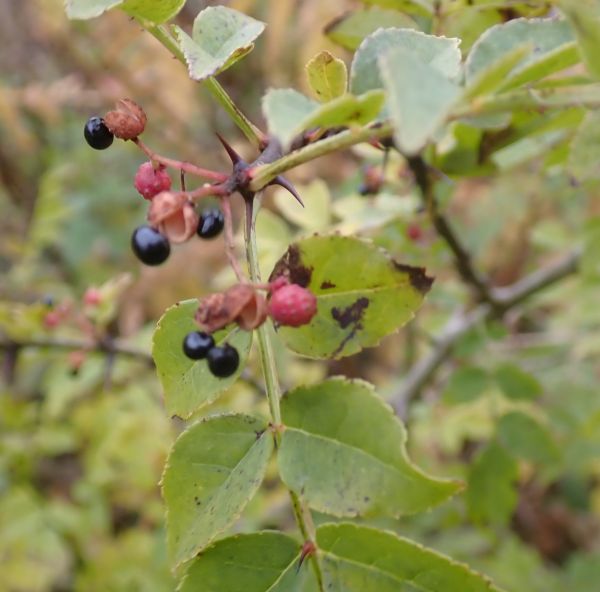
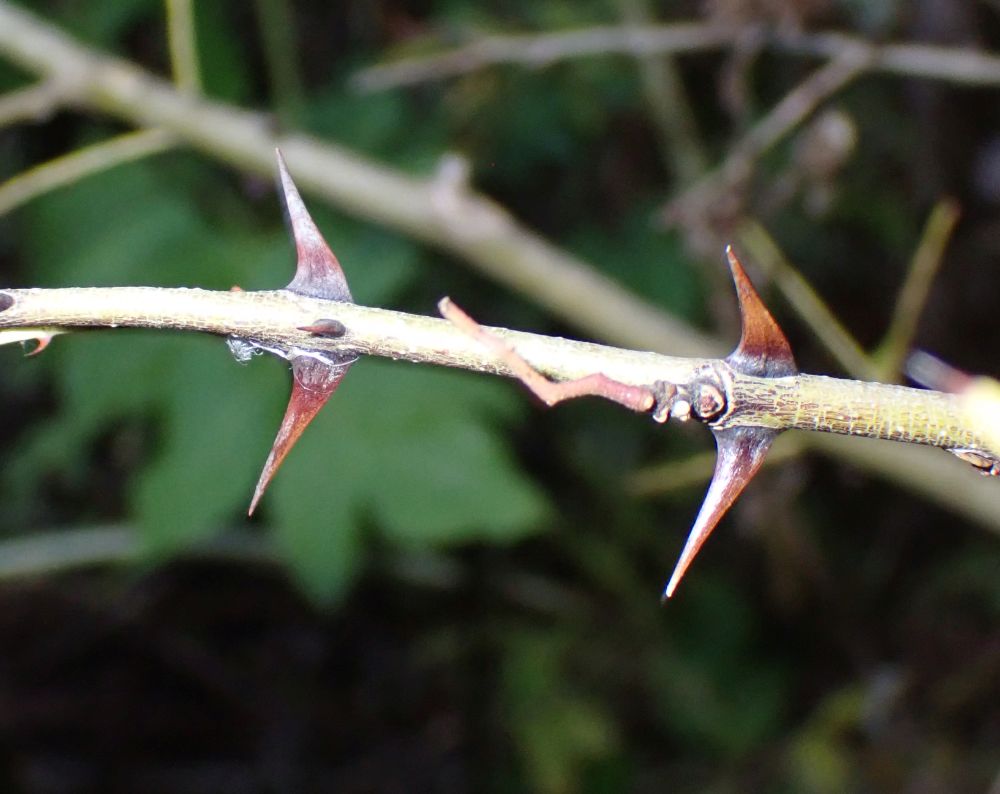
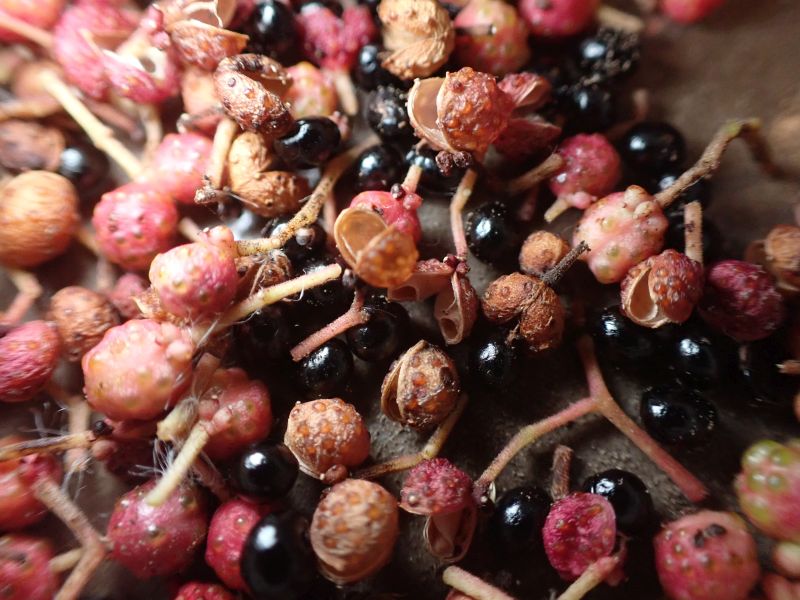
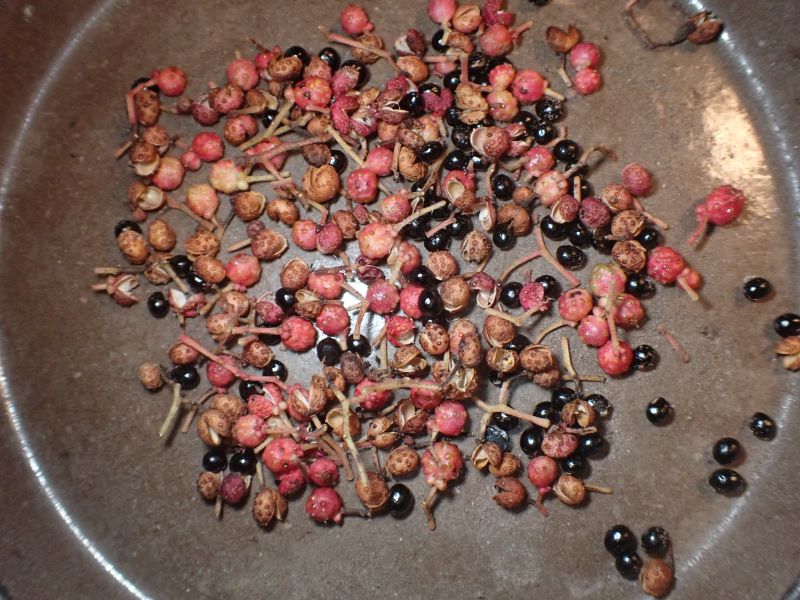
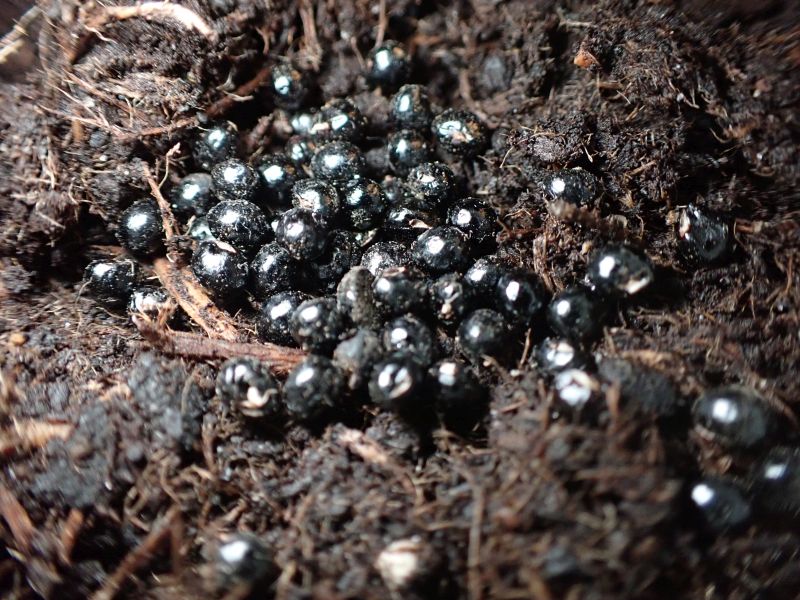
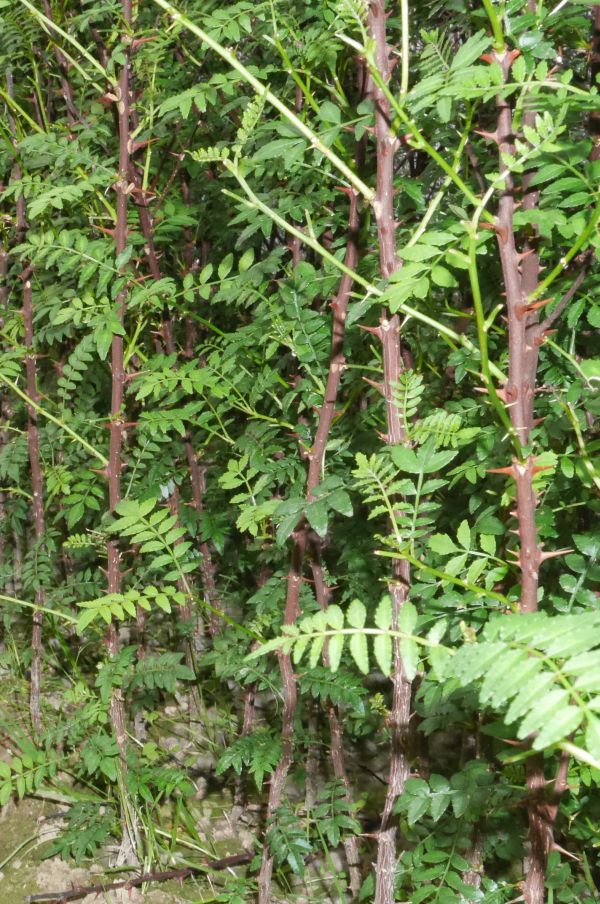
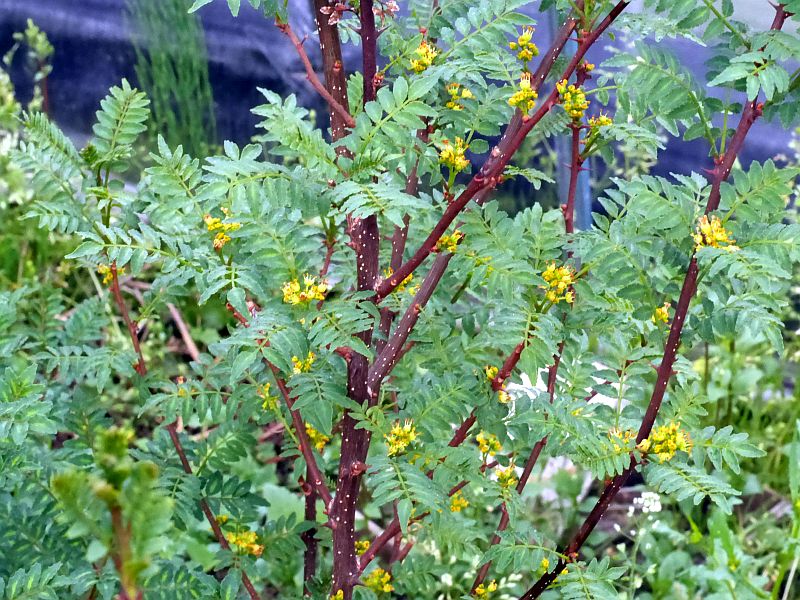
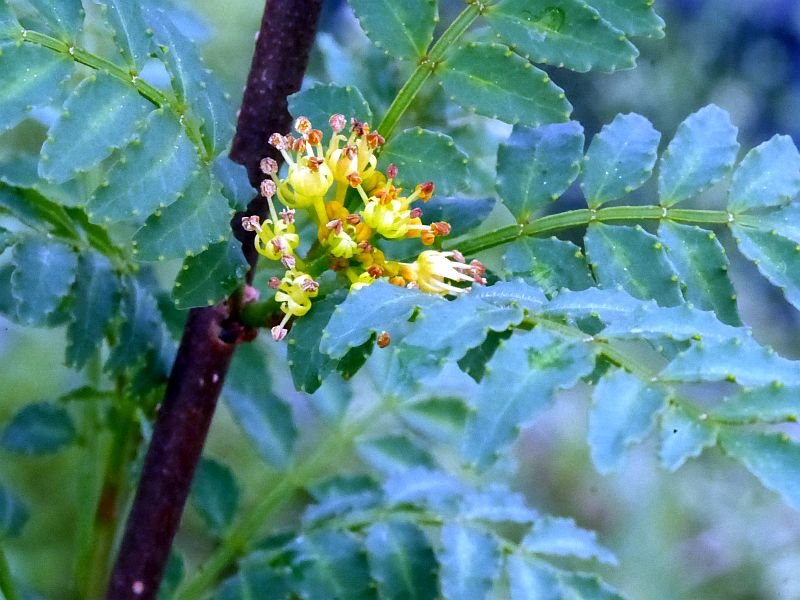
Zanthoxylum is a genus of some 250 species of deciduous and evergreen trees, shrubs and climbers in the citrus family, Rutaceae To my great surprise, I discovered that a plant I received from my friend Bo Blomkvist in Sweden as Zanthoxylum schinifolium and planted in July 2020 had numerous fruits on it. However, the taste was very similar to Japanese pepper, Zanthoxylum piperitum, and I believe it is this species I have as it has spines that grow in pairs (picture) whereas schinifolium has solitary spines. It is known as sanshō (山椒) in Japan and chopi (초피) in Korea.
Pairs of thorns separates Zanthoxylum piperitum from Z. schinifolium
Sowing seed
I have tried to grow Z. piperitum, including the thornless variety inerme, several times in the past (always from seed as there was no source of plants in Norway) but I have only once experienced a plant reaching the flowering stage for a couple of years, but no fruits developed, subsequently dying. I’ve also tried other species such as Zanthoxylum americanum and Z. simulans, but they also died in the winter. This plant is the only surviving one in my garden. I was surprised to find fruits as sources I’d read say that Z. piperitum is reliably dioecious, i.e, it has separate male and female plants. On the other hand, some species such as Z. schinifolium are sometimes monoecious or hermaphroditic. I note though that our friends at the Balkan Ecology Project have also found it to be hermaphroditic; see https://www.balkep.org/zanthoxylum-piperitum.html
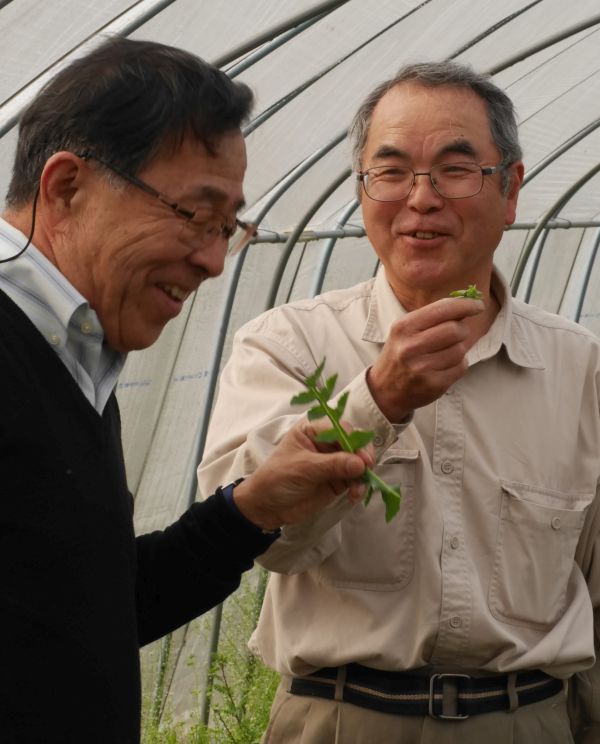
I’ve now sown the seed (they need stratifying and shouldn’t dry out before sowing) and will also try to propagate by cuttings later in the winter, the combination of an apparently hardier monoecious form of this great spice is worth preserving. I ate sansho frequently during my study tour to Japan back in 2016 and even visited a farm producing the leaves of this plant. I’ve blogged separately about this at https://www.edimentals.com/blog/?p=34098 including much more about the many uses of Japanese pepper!
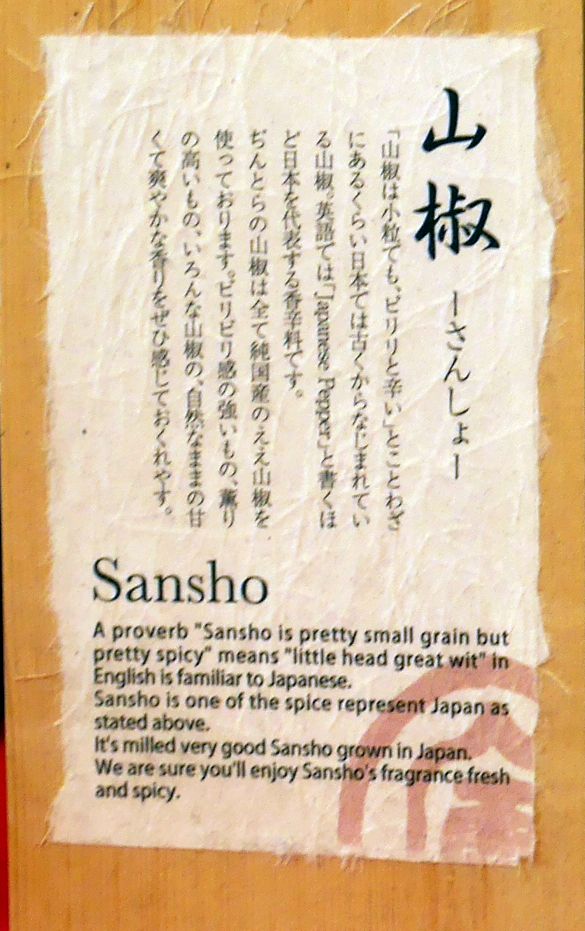
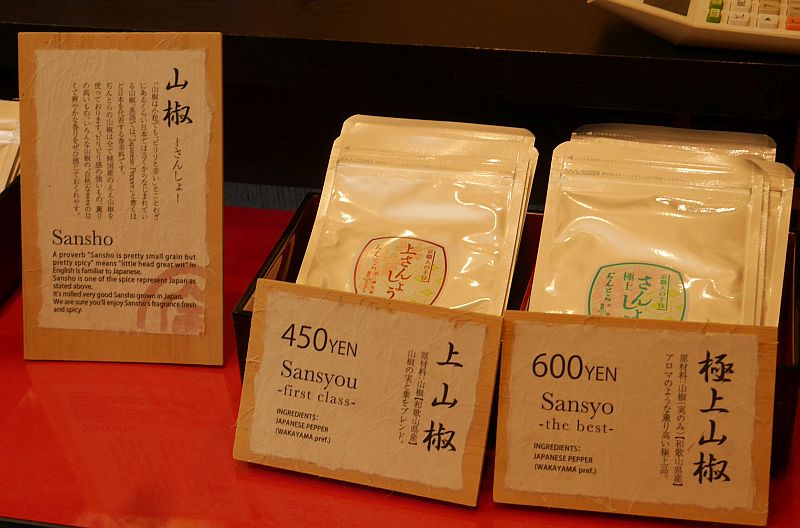
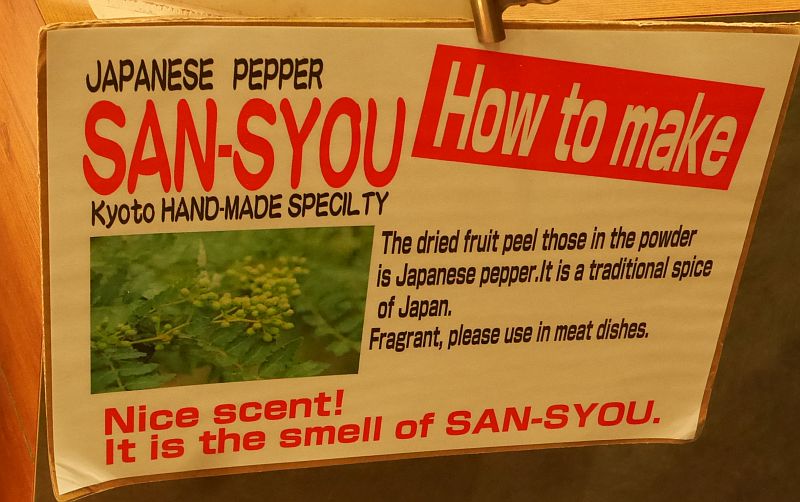
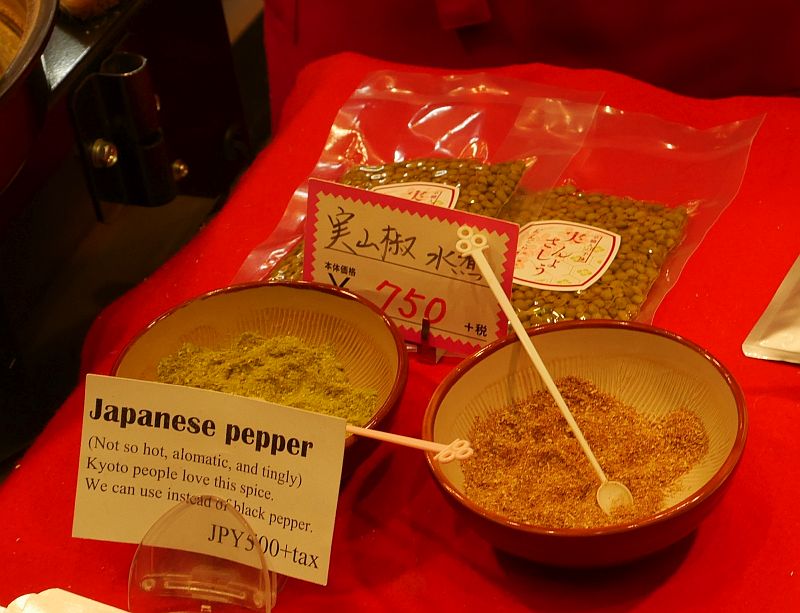
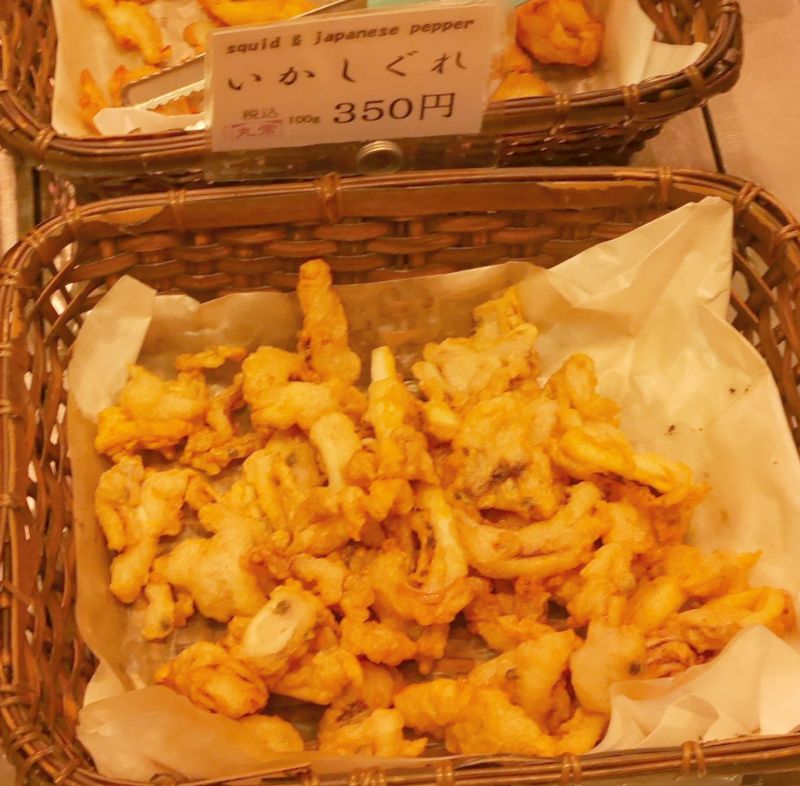
As I’ve acknowledged in various other posts from my spring 2016 study tour to Japan I am forever grateful to Aiah Noack of Naturplanteskolen in Denmark for organising the tour of sansai farms near to the city of Toyota and for the on-the-ground assistance and translation by her plant breeding friend, Teruo Takatomi, and colleagues who had kindly offered to organise a tour of farms for a couple of days. If you’re not familiar with the term sansai, it literally means mountain vegetables, previously wild foraged vegetables nowadays farmed for markets near the urban areas. Before meeting Teruo we spent a couple of days in Kyoto and visited the Nishiki market to familiarise ourselves with local vegetables. Here, the importance of sansho (san as in sansai meaning mountain and sho, pepper) or Japanese pepper (Zanthoxylum piperitum) is in the Kyoto cuisine was obvious with several shops profiling this spice in addition to restaurants and fast food outlets selling sansho dishes (pictures below). See also my blog post celebrating my first harvest in Malvik: https://www.edimentals.com/blog/?p=34090
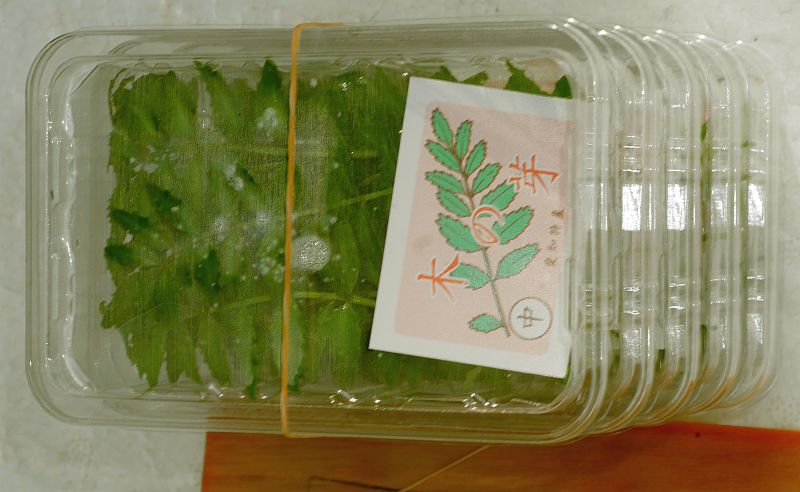
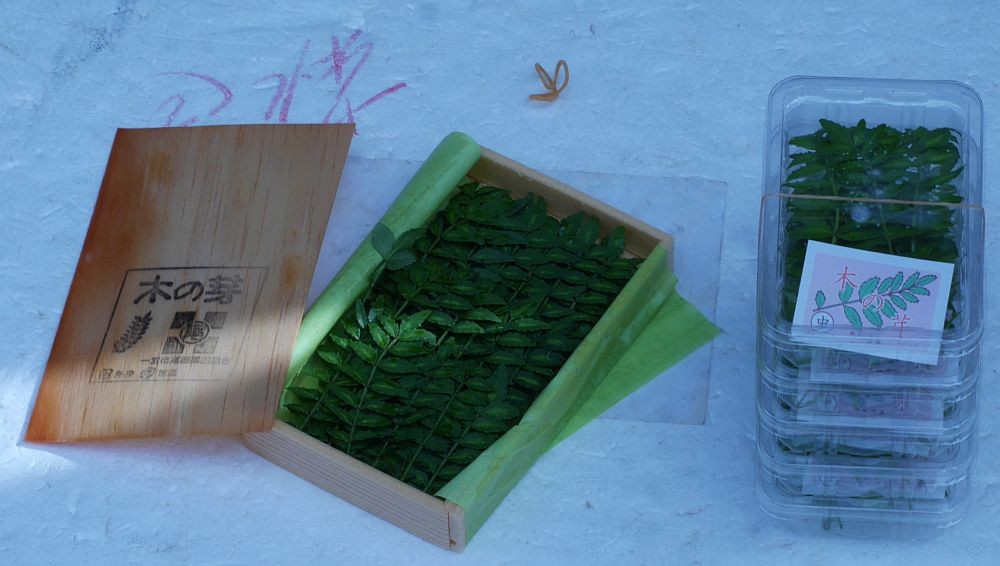
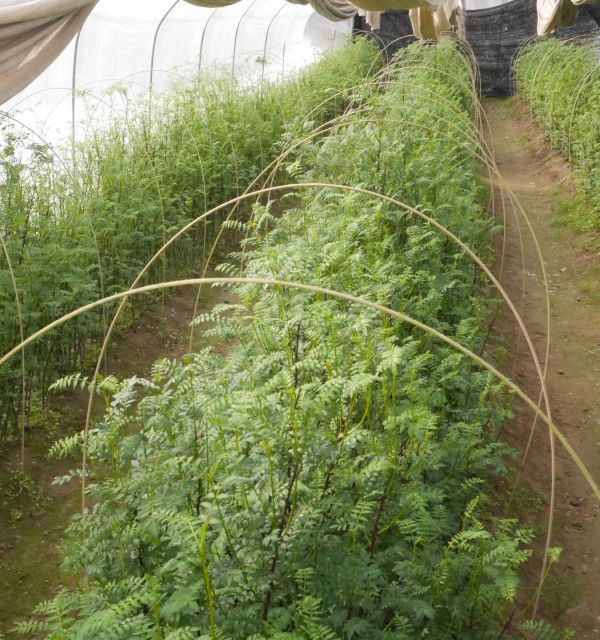
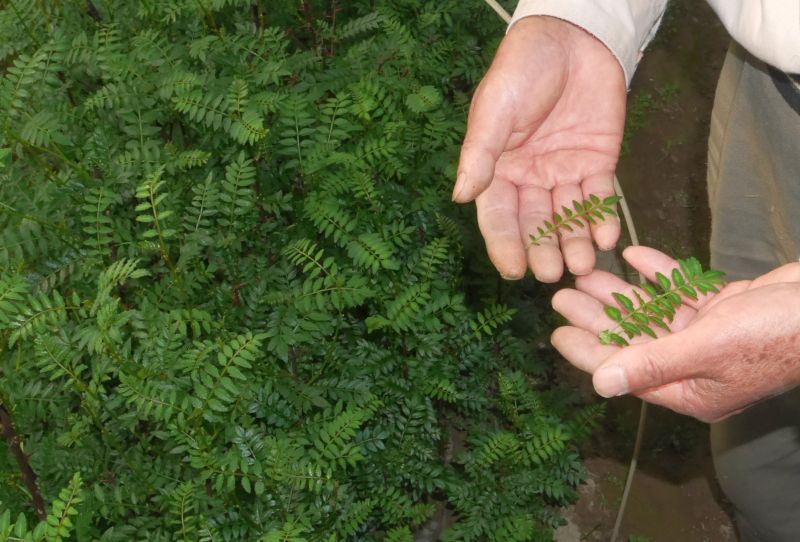
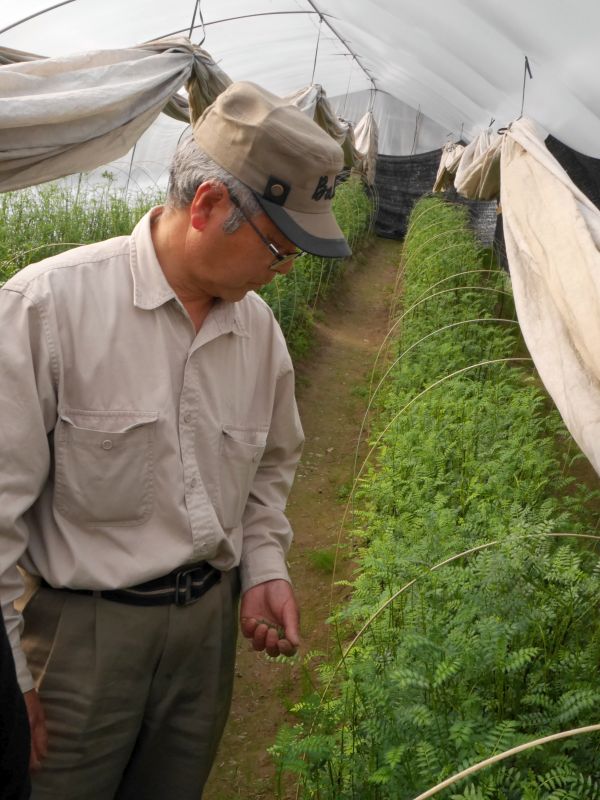
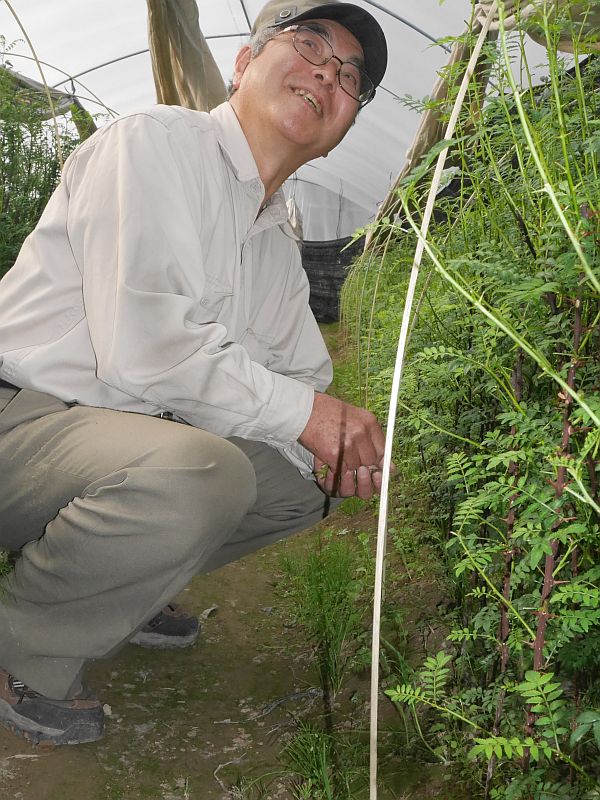
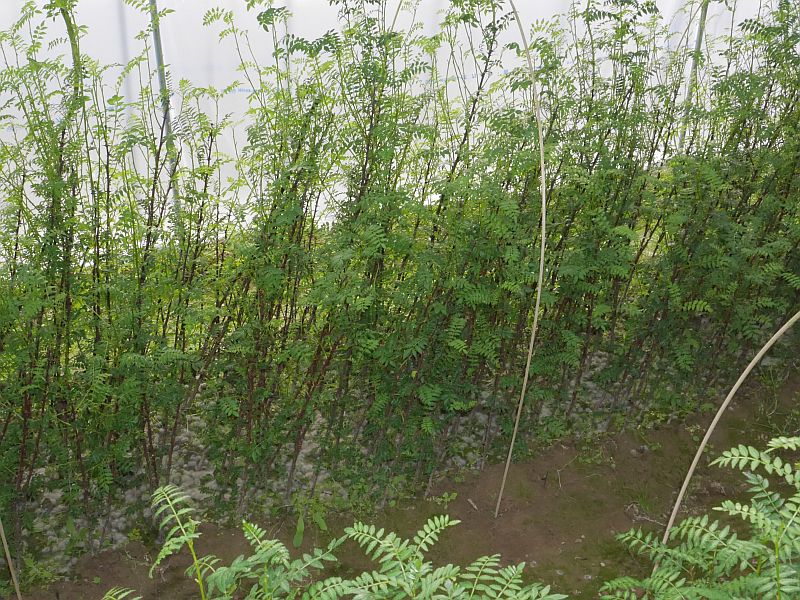
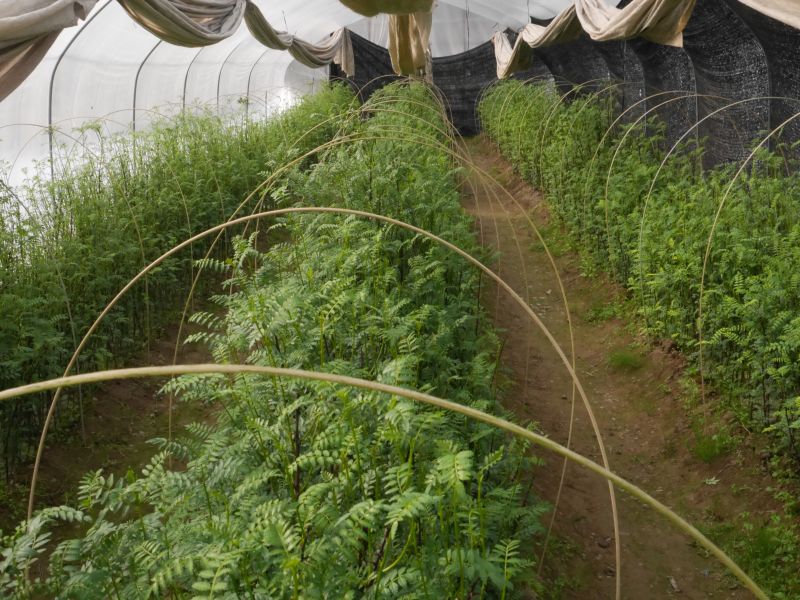
The genus Zanthoxylum includes some 250 species of deciduous and evergreen trees, shrubs and climbers in the citrus family, Rutaceae. Zanthoxylum piperitum is called sanshō (山椒) in Japan and chopi (초피) in Korea. I picked up a Japanese book “I want to know more about Kyoto Vegetables” by Koji Ueda which explains the superiority of the local sansho grown on Mt. Kurama about 15 km north of the city. Translating from the book “Some may question the inclusion of sansho berries among Kyoto vegetables, but for Kyoto residents, who strive for the softest vegetables, sansho berries are an essential Kyoto vegetable. Hatsuhashi and senmaizuke are ubiquitous souvenirs throughout Kyoto, but recently, chirimen sansho has become a staple, almost replacing senmaizuke. This is a tsukudani (simmered dish) of dried small sardines and sansho berries. Chirimen sansho’s success hinges on the tenderness of the sansho berries and their skin. In the past, it was a secret recipe passed down from mother to son from each family. When it comes to sansho berries with soft flesh and skin, the first thing that comes to mind is the sansho berries near Mount Kurama in Sakyo Ward, Kyoto City. The type of sansho is called Asakura sansho, and it’s grown in Tajima Province (Hyogo Prefecture).” The city of Asakura is in Fukuoka Prefecture and here this special thornless variety of sansho originated. The book proceeds to explain that after choice of variety, the next most important thing is when the berries are harvested. If harvested too early they are soft, but break down when cooked in tsukudani. Harvested too late, the skin becomes hard and the berries turn black, turning the entire fruit into a hard, unappetising substance. When berries turn black greengrocers call it “the ohaguro has got in.” (see https://en.wikipedia.org/wiki/Ohaguro). To ensure a good result, you need to use before “the ohaguro has got in”. Other parts of this shrub are also used, including the young leaves, flower buds, flowers, bark and young fruits. One of the sansai farms we visited specialised on producing the leaves, used as a beautiful edimental garnish on various dishes. The leaves had to be “perfect” for use in this way. See the gallery of pictures below from the farm visit.
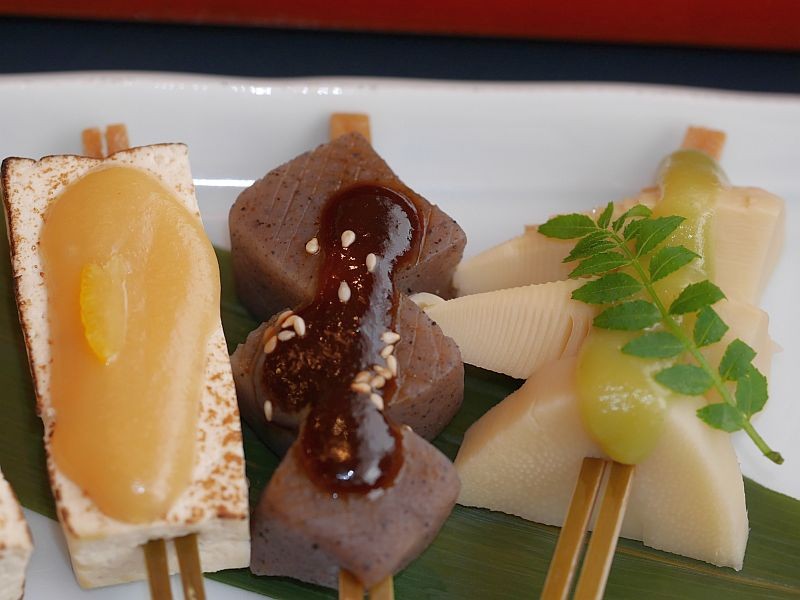
The female trees are grafted and prefer semi-shade. The male trees are also used, most commonly the green flowering buds or hana sansho, a seasonal product in spring (see https://tinyurl.com/bs29zdcs). It’s used as a garnish on various dishes, in tsukudani and other dishes. The flowers are also used, typically sprinkled on soups and other dishes as a spicy garnish. Next available are the immature peppercorns known as Ao-sansho, literally green sansho and these are used in a similar way, in tsukudani, or mixed with dried small sardines to make chirimen-sansho. There are even records of the inner bark being used in the past!
Zanthoxylum schinifolium is also found in the wild in Japan where it is known as inu-sansho or literally dog sansho, referring to the inferior taste of the berries.
5 forms of Zanthoxylum piperitum are named on the Japanese Wiki page:
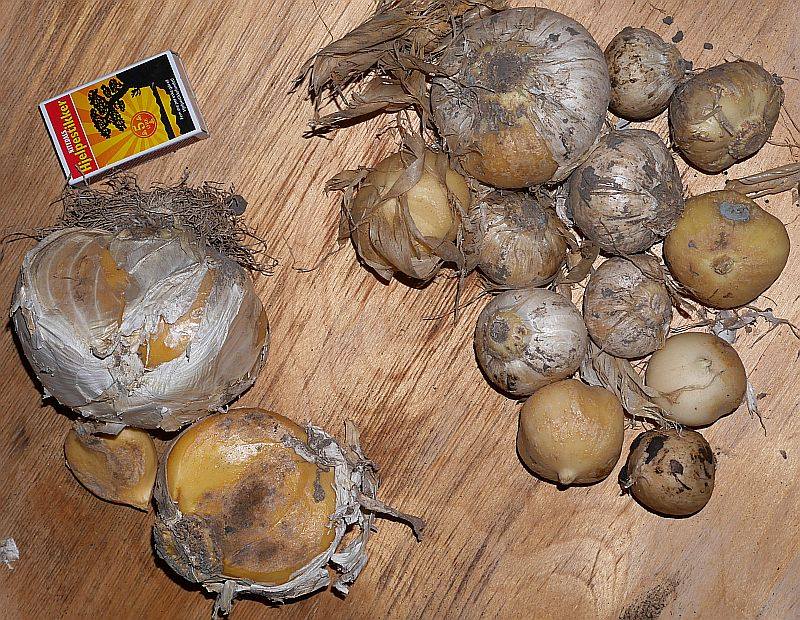
Asakura forma inerme is a thornless cultivar that emerged as a result of a mutation in the 19th century or earlier. It is mainly grown by grafting female plants, as seedlings are sexually indeterminate (males don’t have berries) and can develop thorns. (I once saw this form in the Utrecht Botanical Garden with berries; pictures) Yamaasakura forma brevispinosum is intermediate between the wild thorny species and Asakura with short spines, found wild in the mountains. Ryujinzansho forma ovalifoliolatum has ovate leaflets and only 3-5 leaflets. They are considered edible, but not medicinal. Originates from the Ryujin region of Wakayama Prefecture Grape sansho is believed to descend from the Asakura form and is suitable as it doesn’t grow very tall and produces large fruits, prolific like a bunch of grapes. It is cultivated by grafting female plants. Takahara Sansho (Highland Pepper) is cultivated in the Takahara River basin in the Hida region, is smaller than Asakura sansho and is a fragrant variety.
The Zanthoxylum genus is also known as host of various species of swallowtail butterfly (Papilio sp.) both in North America and the Far East. In Southern Europe the migratory subspecies is known to feed on common rue / vinrute (Ruta sp.) and like Zanthoxylum in the Rutaceae! In 2024, caterpillars were found on a common rue plant being grown in the herb garden at the Ringve Botanical Garden in Trondheim! Perhaps it could turn up on cultivated Zanthoxylum species in Europe.
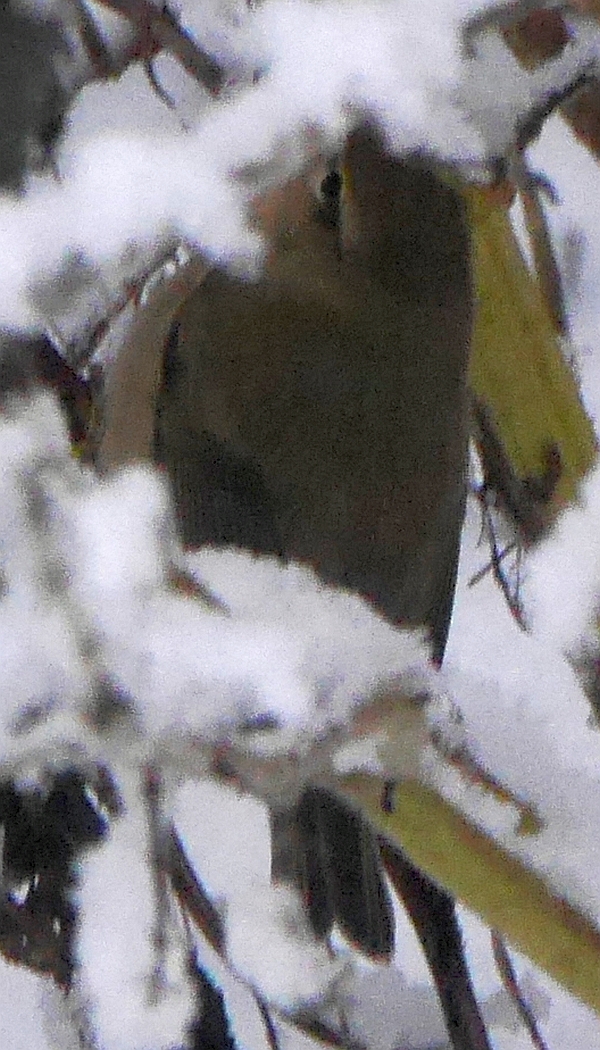
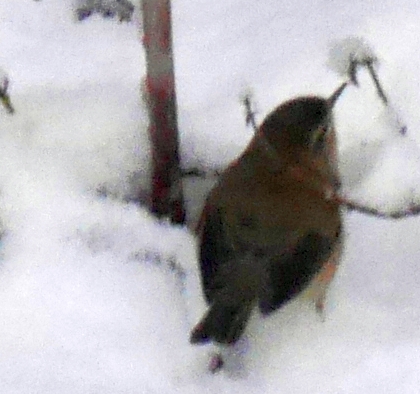
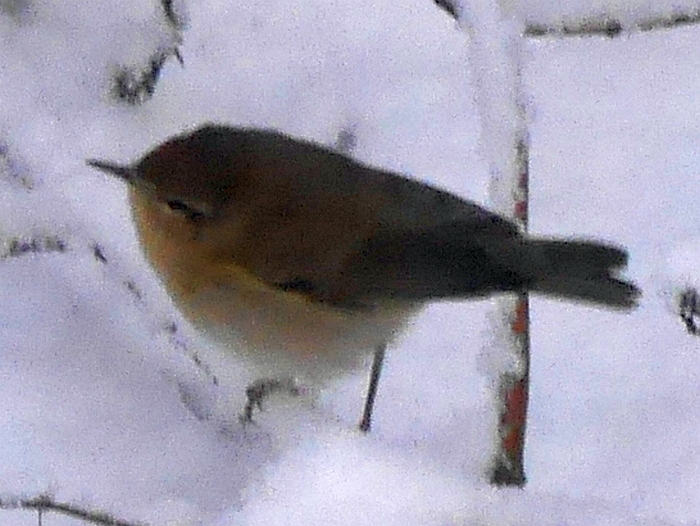
I was surprised a couple of days ago on 16th November to see a chiffchaff (gransanger) flitting about feeding in an apple tree in the garden. I saw it again today and made a short video and a few pictures (below). There’ve been several observations in the neighbouring municipalities recently as part of a trend as our autumn gets longer. However, this seems to be the first ever observation in my municipality (Malvik) in winter (November-February).
I’ve been growing Siberian Ginseng / Russisk Rot (Eleutherococcus senticosus) since I was given a cutting in May 2010. Although flower buds appear each autumn, flowers have never opened here. Nevertheless, it doesn’t freeze back at all. In my extensive Japanese foraging book, Hamimoto’s Wild Food Lexicon, it states it flowers there in August, so I guess the late flowering here is a day-length sensitivity. I propagated it and have a clone now at the Væres Venners Community Garden which is a sunnier site and a few flowers have now opened at the end of October!
The translated by Google Lens entry in Hamimoto follows, hinting at overharvesting for medicinal purposes. Only the latter use is mentioned in Hu’s Food Plants of China, the stem and root used for tea. It states that it was introduced to the Arnold Arboretum in Boston, USA in 1872 and the original plant is still living in good condition (2005). Is it still there?
Eleutherococcus (Acanthopanax senticosus): A deciduous shrub 2-4m tall. The branches and petioles are covered with soft, downward-pointing spines. The spines are thin and densely distributed lower down the trunk, thicker and more sparsely distributed in the middle, and often absent higher up. It is believed that the plant grows its finely arranged spines as a defense against small animals like rabbits, and then thickens and sharpens its spines to protect itself from Hokkaido deer and Japanese serows. Flowers bloom in August and are dioecious. The slightly liquid drupes appear in late September. Young shoots and leaves are great for tempura. The liquid drupes and branches can be used to make a spicy liqueur, but they are best left alone to protect the environment. Found also in Sakhalin, the Amur region, China, and Korea. Dug for medicinal purposes, populations are small.
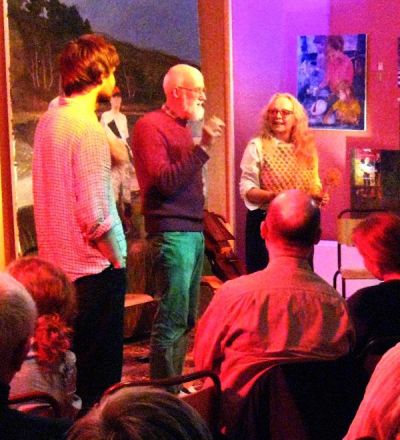
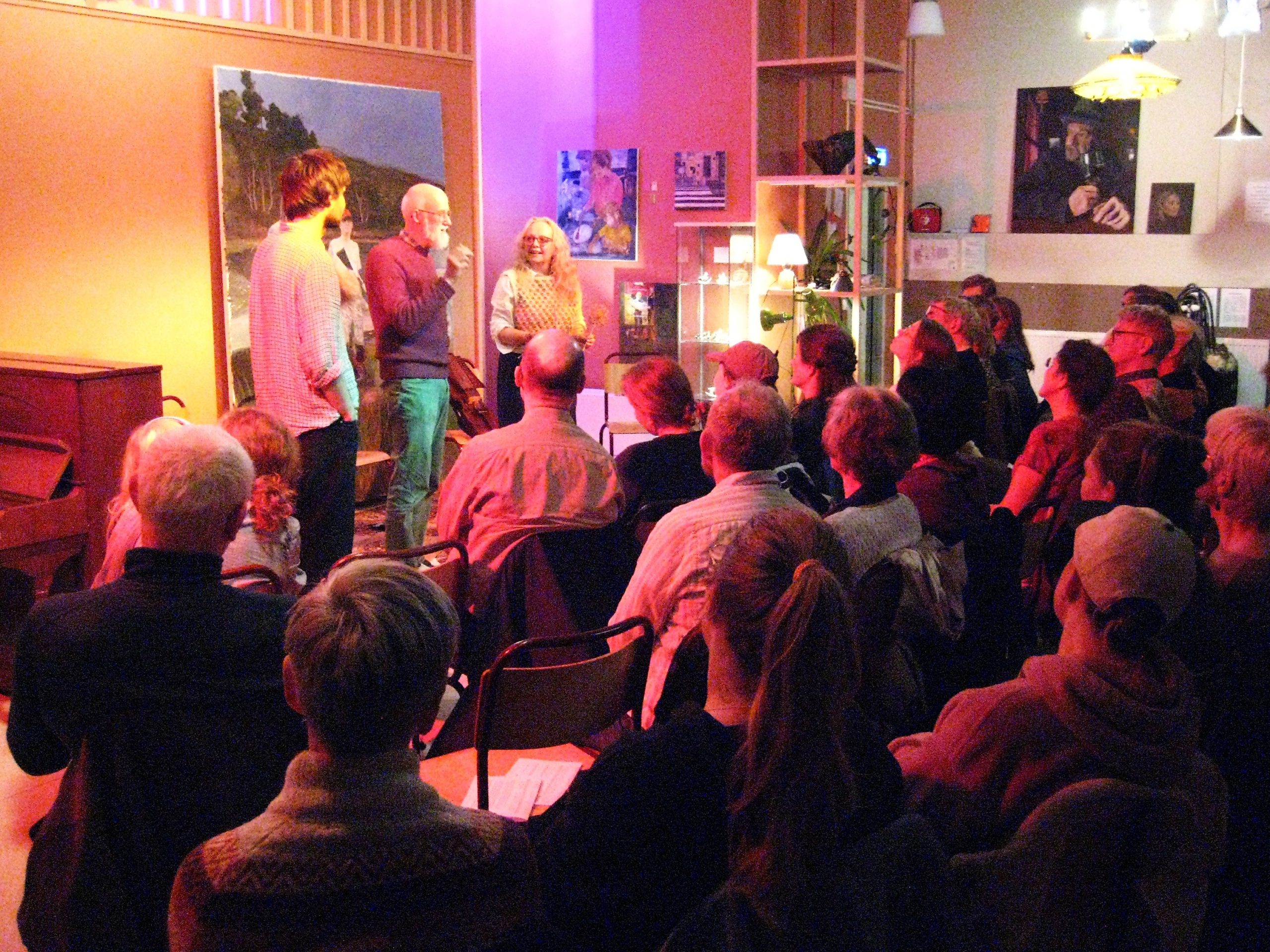
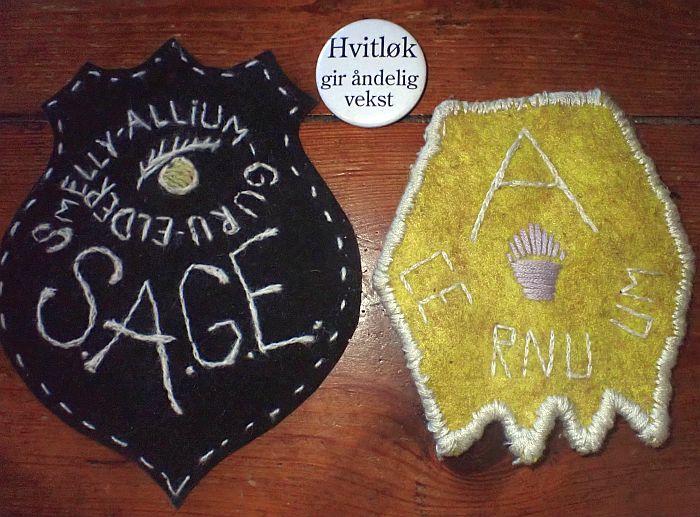
I enjoyed myself last Tuesday evening talking about onions with Marianne Meløy and Amund Storløkken Åse, surrounded by some amazing art at Atelier Ilsvika, in an eclectic acoustic mix of traditional Norwegian folk music (Guro Kvifte Nesheim kvintett), jazz, ethnobotany, Alliums, humour, Peer Gynt’s philosophical onion and vampires! And they even performed a crazy traditional Swedish folk song “Røkt gjøk med løk” (smoked cuckoo with onions)! See https://www.youtube.com/watch?v=P92JsFOLjtY and https://www.itromso.no/feedback/i/Bjqezl/dette-er-tidenes-10-psykeste-later I wore my “Hvitløk gir åndelig vekst” badge (pictured below with two other wonderful onion badges created by my artist daughter Hazel that I didn’t have time to present!)
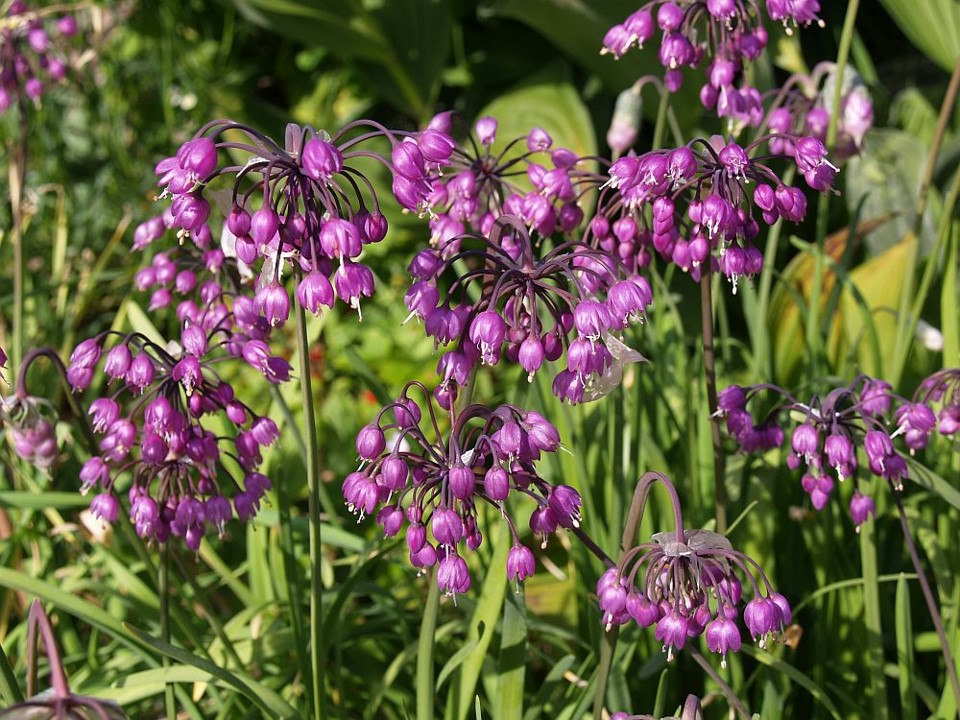
The badge bottom right says A cernuum, my favourite Allium aka the Chicago onion
Below are some Allium “fun facts”, not all of which I mentioned:
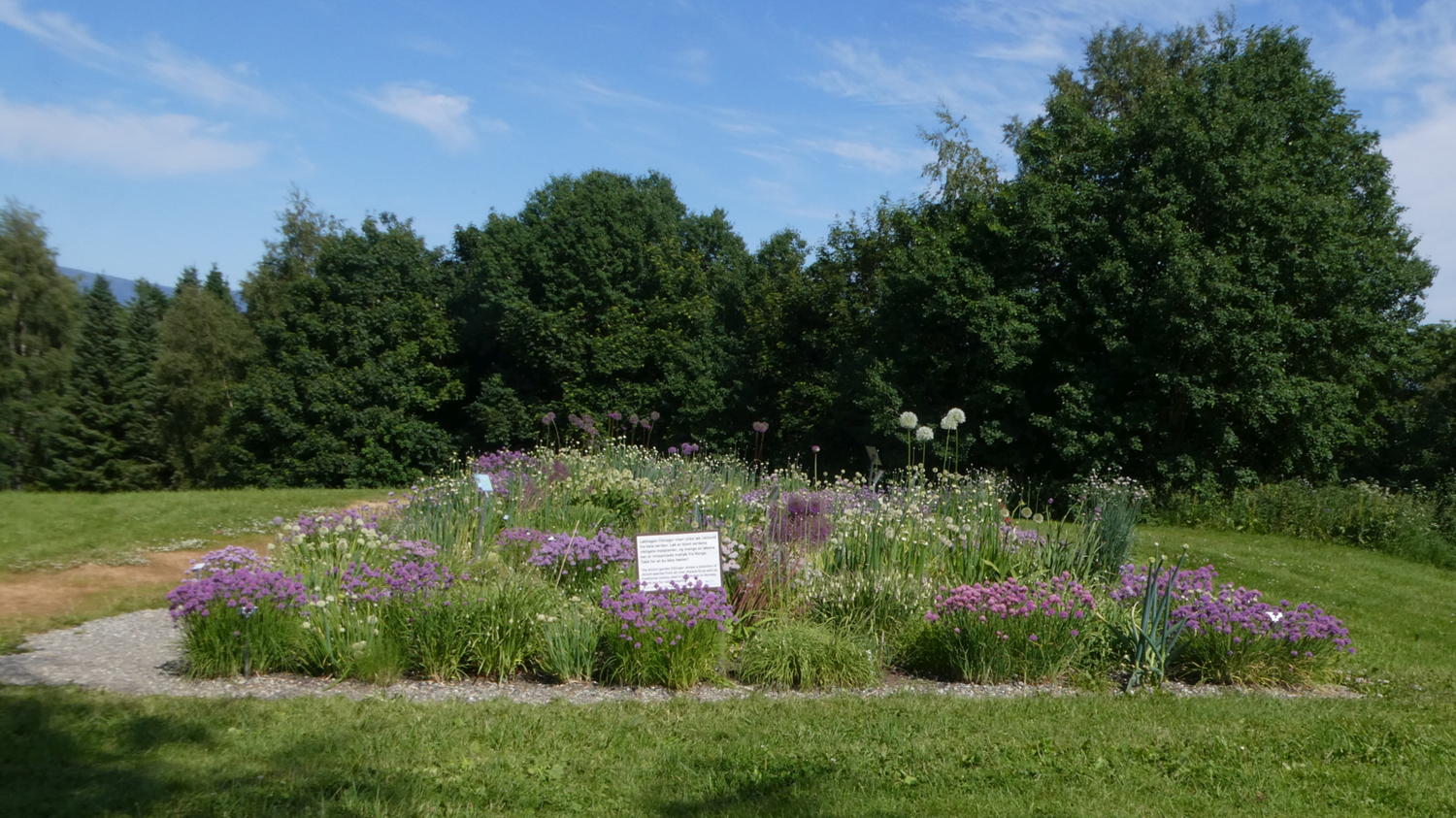
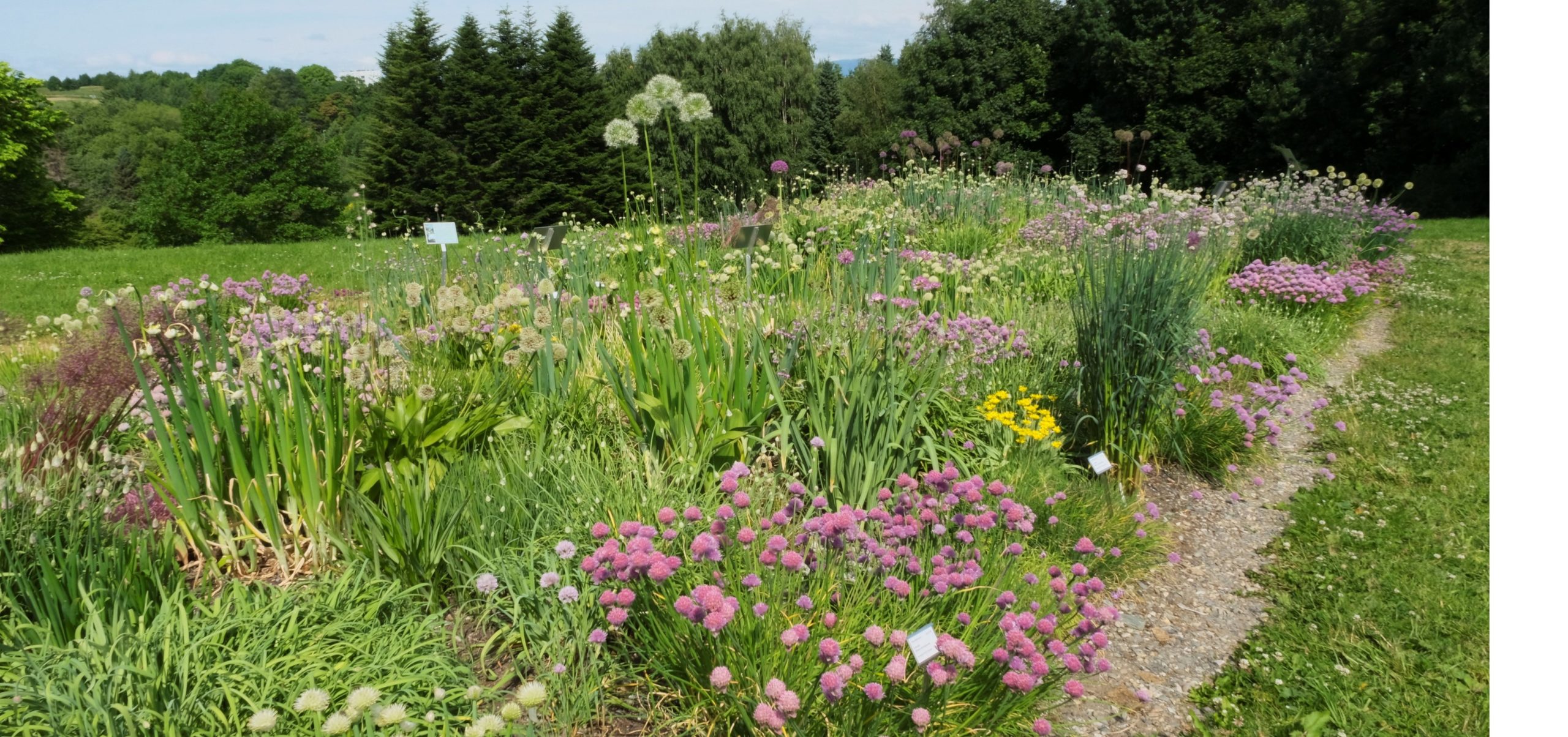
-The Onion Garden Chicago (Løkhagen Chicago) at the NTNU Ringve Botanical Gardens in Trondheim is one of the world’s largest collections of Alliums with over 100 botanical species, over 400 different onions including cultivars and a collection of some 60 old Norwegian onions collected throughout Norway from Lindesnes to Finnmark and from sea level to mountain villages.
-Chicago means “stinking place in the woods” in one of the local indigenous languages (built in an area originally huge stands of Alliums including Chicago onion – prærieløk; Allium cernuum) – see my daughter’s badge! – There are around 930 Allium species in the world and many are wild foraged and domesticated locally and worldwide for food. Almost all are from the Northern hemisphere, with a few in South America and one in South Africa where close relatives the society garlics (the genus Tulbaghia) are found and can be seen in flower in autumn in the Onion Garden, but are overwintered inside.
-Linnaeus described the Allium genus in 1753.
-Although Norway has no Allium species in the mountains, we probably have the world’s northernmost wild onions growing at Knivskjellodden, near to and north of Nordkapp – this is Siberian chives (sibirgressløk or lávki) which gives an “interesting” flavour to cow and reindeer milk!
-The old Norwegian onions include Egyptian / walking onions (luftløk / etasjeløk), Welsh onion (pipeløk), chives (matgressløk), Siberian chives (sibirgressløk), ramsons (ramsløk), German garlic (kantløk), Victory onion (seiersløk) and sand leek (bendelløk). We have a collection of field garlic (vill-løk) and crow garlic (strandløk) elsewhere as they are too “weedy”.
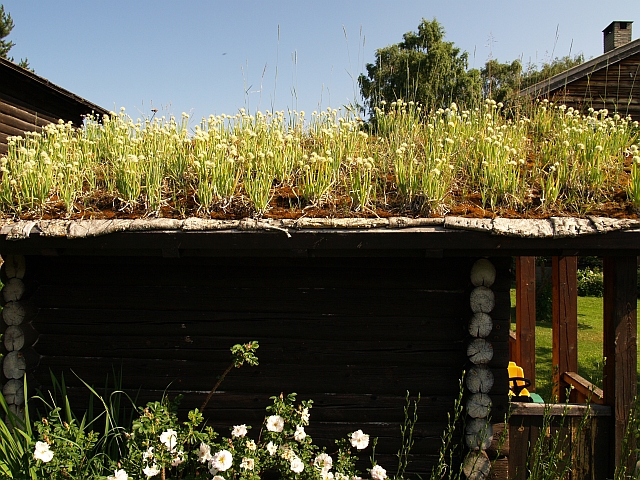
-Norway has surviving roof onions (takløk) in the Gudbrandsdalen valley grown traditionally on turf roofs to protect against fire and to provide onions for scrambled egg in the spring. This is Welsh onion (piepløk) Allium fistulosum from Siberia, but they have been evolving for such a long time on these roofs, self-sowing each year, that some botanists consider it a new species which could be called Allium gudbrandsdaliensis!
-The most eaten onions in the world are the common bulb onion / kepaløk (Allium cepa), leeks / purre (Allium ampeloprasum), garlic / hvitløk (Allium sativum) and shallots /sjalottløk (Allium cepa var. aggregatum); the latter two are vegetatively propagated from the bulbs or bulbils (garlic) but the other two are mostly started from seed and die after flowering and setting seed in year two. In my part of the world, the season isn’t long enough for seed to mature outside so that we have to import seed and we are not then self-sufficient.
–Allium cepa (kepaløk) isn’t found in the wild and the closest wild progenitor from which it evolved is Vavilov’s onion, perennial Allium vavilovii. Shallots (sjalottløk) are a perennial variety of the bulb onion much grown throughout Norway up to the 1970s. A number of old varieties, available through KVANN, are seeing a renaissance as people realise how important they are for food security in Norway. Similarly, Johannes’ shallot (sankthansløk) Allium x cornutum is an interesting perennial hybrid shallot, harvested around mid-summer – Allium cepa is one of three parents.
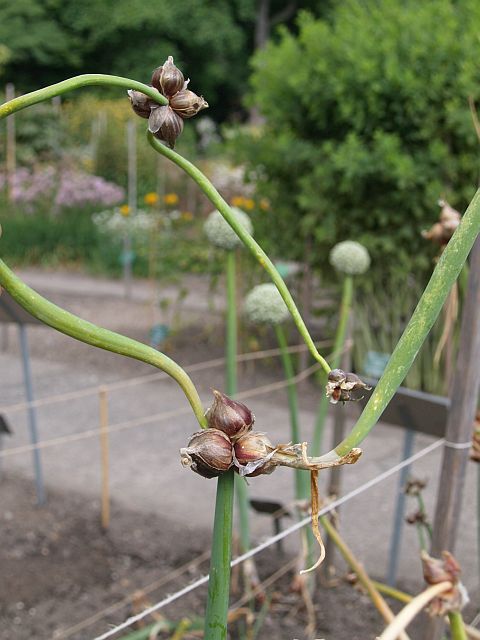
-Luftløk or etasjeløk (Egyptian onion) is another hybrid with Allium cepa, this time with Allium fistulosum which forms large topset onions instead of seeds. The stems collapse in autumn falling down and planting the topsets at some distance from the mother plant, hence walking onions in North America. Etasjeløk is the variety forming several levels of topsets as they sprout and form new topsets. This is the Catawissa onion of North America, deliberately crossed at the Catawissa research station in the 1870s and, due to its curious form and ease of multiplication is now found worldwide.
-Chives (gressløk) is the only Allium species found both in Europe, Asia and North America and it has also naturalized in other parts of the world.
-Ramsons (ramsløk) has become very popular for making pesto in the last 10-15 years and wild stands have been overharvested in parts of Norway; KVANN published so-called “ramsons common sense rules” (ramsløkvettreglene), written by botanist Klaus Høiland a few years ago; see https://www.edimentals.com/blog/?p=34038
-Allium chemistry is complicated due to the complex mix of sulfur compounds they contain and a book was written on this subject: Eric Block’s Garlic and Other Alliums: The Lore and the Science
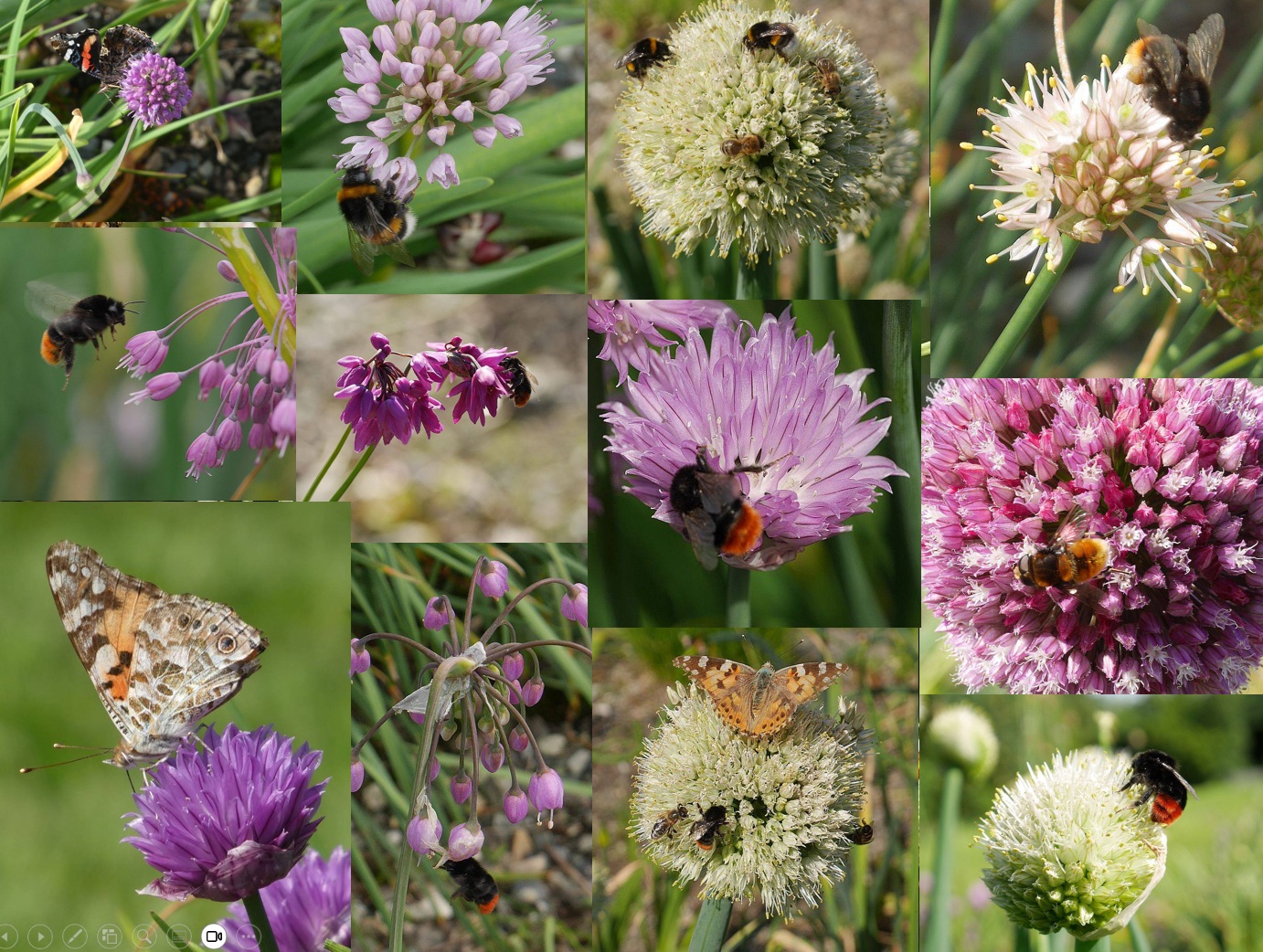
–Alliums are some of the best pollinator-friendly plants attracting a range of bumble bees, wild bees, hoverflies and other insects.
-There are no surviving old varieties of garlic (hvitløk) in Norway, unlike Sweden and Denmark; The variety Valdres introduced to Norway from Belarus by Anders Nordrum and Aleksandra sent to me from Finland, a Russian variety grown there for 80 years, in the early 2000s alongside Estisk Rød (Estonian Red) via Denmark all appear very similar and may be the same cultivar, having arrived in Norway by different routes.
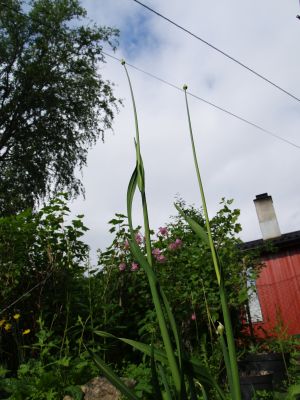
-The Vikings grew onions in their enclosed onion gardens (laukgard); we don’t know which species they grew but it is likely that they cultivated several including one known as Geirlauk (old Edda); the boy’s name Geir literally means a spear, so this was an onion resembling a spear. Geirlauk has the same linguistic derivation as garlic (old English gārlēac). There are at least two candidate species for the original geirlauk (there is no evidence they had real garlic, although it’s not impossible). My best guess is that it was sand leek / bendelløk (Allium scorodoprasum) which is up to 2m tall and slender, more spear-like than garlic. It is often found today near where Viking settlements had been in Scandinavia.
-Some onions grow better in northern Norway than the south such as victory onion / seiersløk (Allium victorialis) which has naturalized in a big way in the Lofoten Islands (Vestvågøy). It has been suggested that it could have been introduced and cultivated by the Vikings and for that reason has been planted alongside Siberian chives in the onion garden at the Lofotr Viking Museum on Vestvågøy, an important settlement in the past. This species could be described as ramsons / ramsløk on steroids and is the go-to onion for home gardens in the north. Delicious seiersløk-pesto can be purchased in Lofoten.
Allium scorodoprasum is spear-like
-Another candidate as geirlauk is field garlic / vill-løk (Allium oleraceum), a wild species with a local distribution from southern Norway along the coast to Troms and to higher elevations in the Gudbrandsdalen valley. Some years ago during an open garden day at home I mentioned my project collecting old Norwegian onions and two young men who had come along as they were interested in my hop collection for brewing participated. One of them told me of an onion that grew locally where he lived on the island Tautra, known as geirlauk, and I was excited to find out what this was. He wouldn’t tell me where exactly it grew as it was a closely guarded secret as it was prized locally and by family visitors. I was disappointed to see that it was no more than Allium oleraceum but fascinating that this name was still in use perhaps pointing to its cultivation in the past on this historical island. Later the same year at a Nordic ethnobotanical seminar in Copenhagen I heard that this species was the only onion to be found on Iceland and not only that but in old documents there was a story that this onion was introduced where it’s still found today by an English missionary bishop who had got it from an island off Nidaros (Trondheim) around the year 1040. Later that year the onions from Tautra “met” the Icelandic onion again for the first time in almost 1,000 years in my garden!
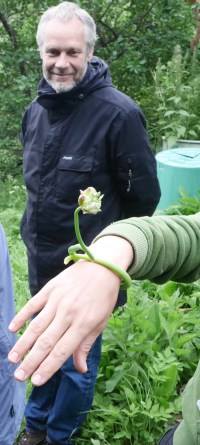
-The best protection against vampires is, of course, garlic (other Alliums work too!) and my daughter presented me with an onion armband (picture) when I travelled to Transylvania one year. There is actually a Transylvanian garlic which was taken to North America by settlers. It is sold commercially in the US and the following is the description accompanying it: “If you are troubled by vampire or blood-sucking in-laws, this is well worth growing”.
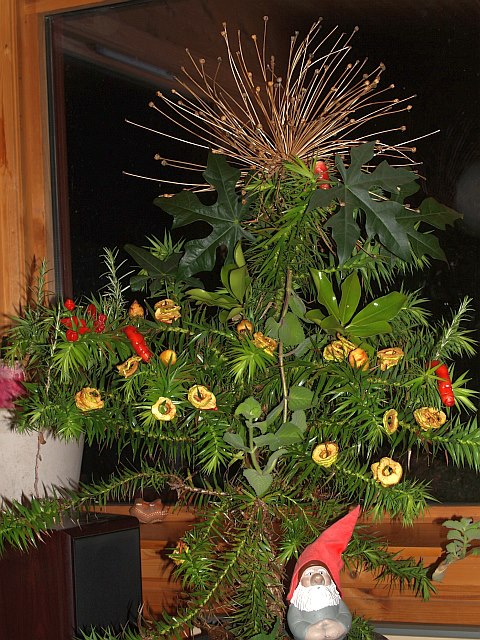
-Allium schubertii is known as the Firework onion and can be used both at the top of your Xmas tree and at New Year as a pet-friendly firework!
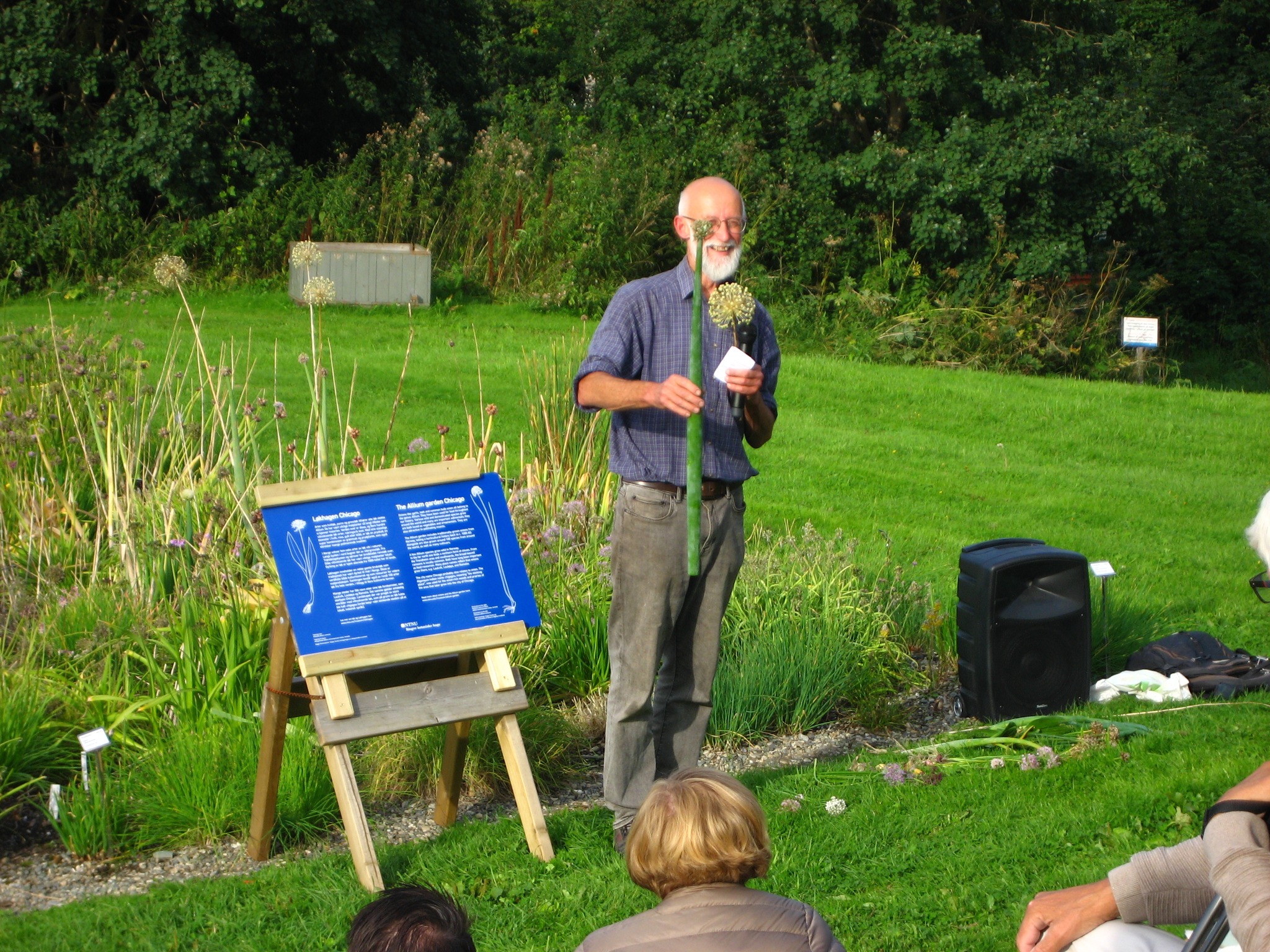
-The concert series at Atelier Ilsvika is acoustic, so a perfect event for the Alliophone (the seed head of Allium stipitatum) which I presented to Marianne! Here I am at the opening of the onion garden at Ringve equipped with one of these:
–Allium stipitatum is probably the commonest species sold as ornamental onions (prydløk) in the autumn in garden centres, grown for its beautiful spherical flower heads. However, it is more than that, a delicious easily grown perennial onion known as Persian shallots. The large onions are grown on farms in Iran, sliced and dried and sold worldwide in Iranian supermarkets. In Iran, it is used in Mast-o Musir, a national yogurt dip with rehydrated Persian shallots and spices like golpar (ground seeds on Trømsøpalme, Heracleum persicum)!
The last time I led a foraging trip with ramsons (ramsløk), Allium ursinum, as the main focus was in 2014 on the island Hvaler in south eastern Norway near the Swedish border. This was at the time the ramsons-pesto trend was really taking off and major gourmet restaurants were paying good money for the leaves. I was shocked to see that a large area had been indiscriminately cut to the ground and I suspected commercial harvest. Since that time similar reports have come in, even from nature reserves which is illegal and there have been declines in the wild stands of this plant. In my area I heard of a chef in Trondheim bragging of big hauls of ramsons in locations at the very north of the plant’s range and at location the plants had almost disappeared. Similarly, a concerned friend showed me pictures of commercial harvesting in a nature reserve in the neighbouring county of Møre og Romsdal. Well known botany professor Klaus Høiland was also alarmed by developments and published a list of ten common sense rules (ramsløkvettreglene) when harvesting this plant from the wild. This was published in KVANN’s (Norwegian Seed Savers) newsletter and we asked people rather to grow in their gardens and to share seed and plants to fellow members. A similar development happened in North America with a similar looking Allium species ramps, Allium tricoccum, where local populations have been overharvested and cultivation has started to compensate on Native American lands (unlike ramsons, bulbs are collected in North America). Ramsløkvettreglene are repeated below (in Norwegian). I would now include Nordmøre and areas close to Bergen and Stavanger as areas where only small amounts should be harvested. Jakta på ramsløken er i gang! Men viss du plukkar i eit verneområde kan det vera forbode.
Den kjente professor og sopp- og nyttevekstspesialist Klaus Høiland har laget disse “ramsløkvettreglene”:
1) Plukk ramsløk greit på Vestlandet, Sørvestlandet og Sørlandet. Der er det rikelig av den.
2) Plukker du på Østlandet, Nordvestlandet og i Trøndelag og nordover, la små bestander stå i fred, og vær forsiktig – ramsløk er ikke vanlig i øst, nordvest og nordover.
3) Se etter at det ikke er fredet. Står det fredningsskilt er det forbudt å plukke ramsløk, som alle andre planter og trær i fredningsområdet. Sjekk uansett om det er fredet, hvor enn du har tenkt å plukke.
4) Respekter innmark, og spesielt mark rundt hus. Noen kan ha plantet ramsløk der, den kan du ikke plukke. Spør alltid grunneier om lov om du vil plukke nær hus.
5) La det alltid stå noen planter igjen, sjøl om du plukker i ei rik li med ramsløk på Vestlandet.
6) Ikke dra opp plantene med løk og rot. Det er bladene som smaker.
7) Er det andre som allerede plukker der, finn et annet sted. Da begrenses også beskatningen på området.
8) Ikke plukk mer enn du trenger.
9) Trå forsiktig, ramsløk vokser ofte i slitesvak skogbunn.
10) Lær forskjellen på ramsløk og liljekonvall
Perennial vegetables, Edimentals (plants that are edible and ornamental) and other goings on in The Edible Garden

 The badge bottom right says A cernuum, my favourite Allium aka the Chicago onion