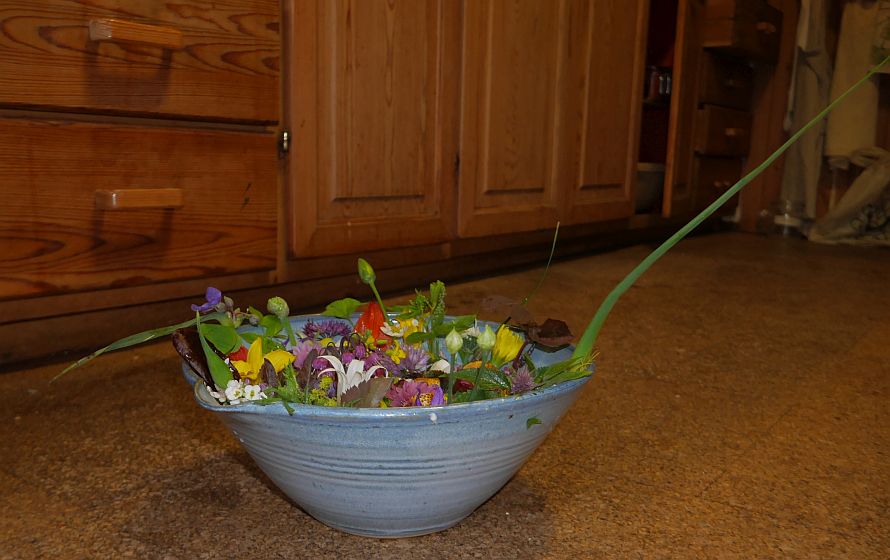
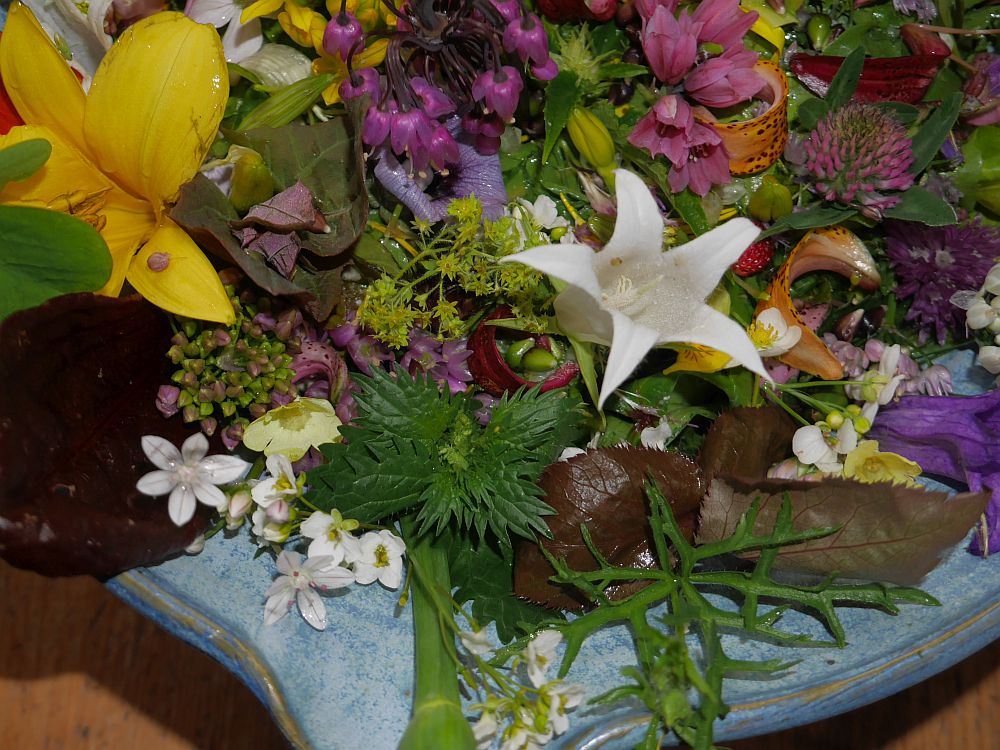
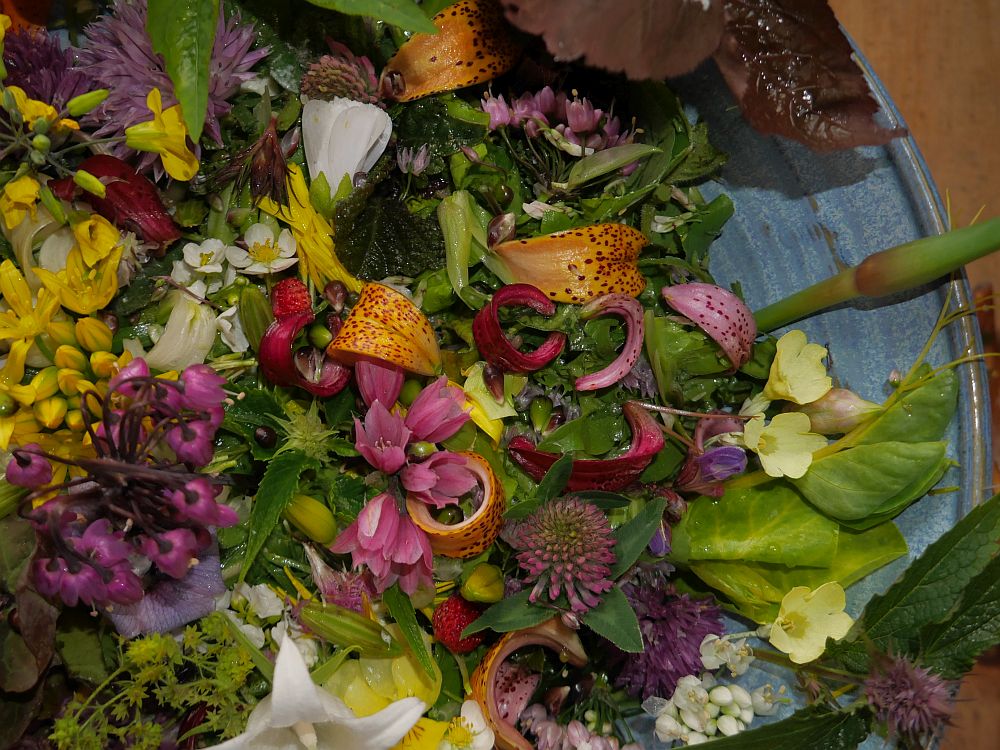
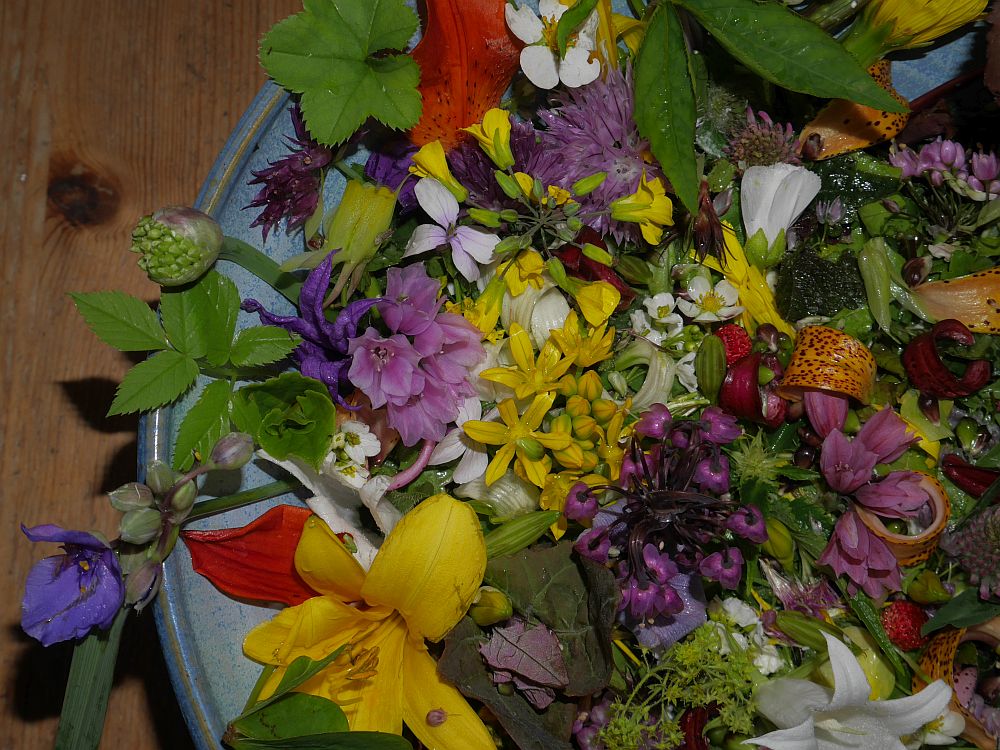
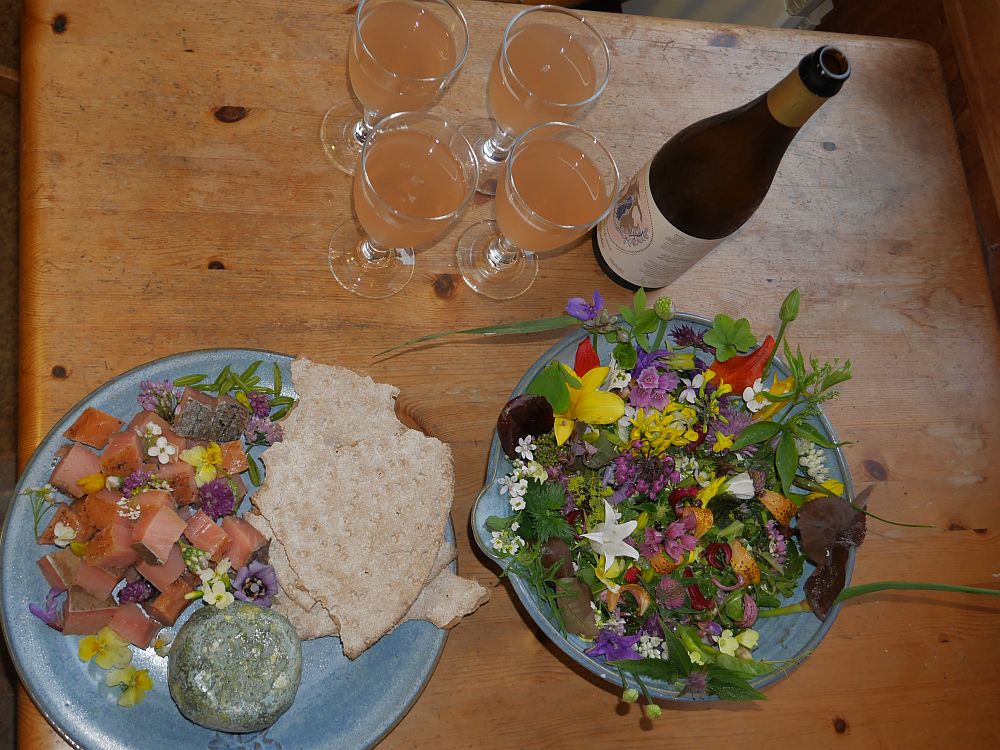
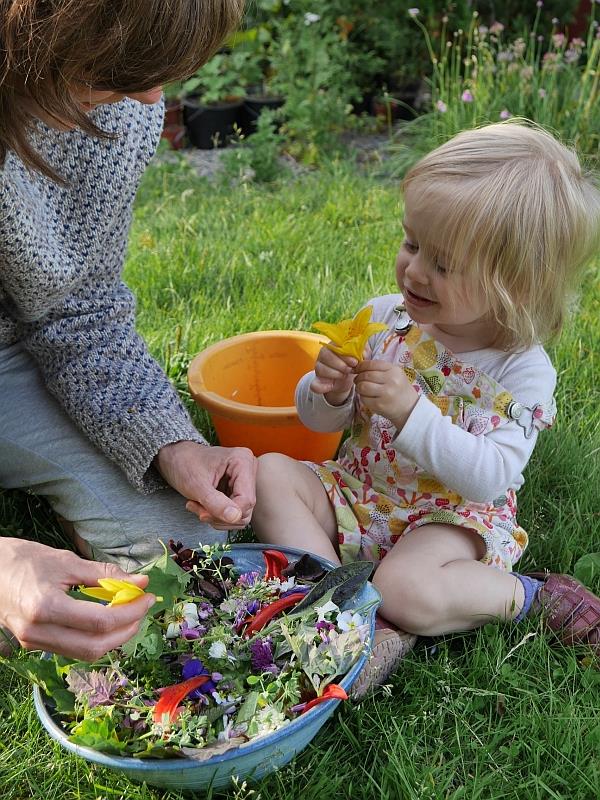
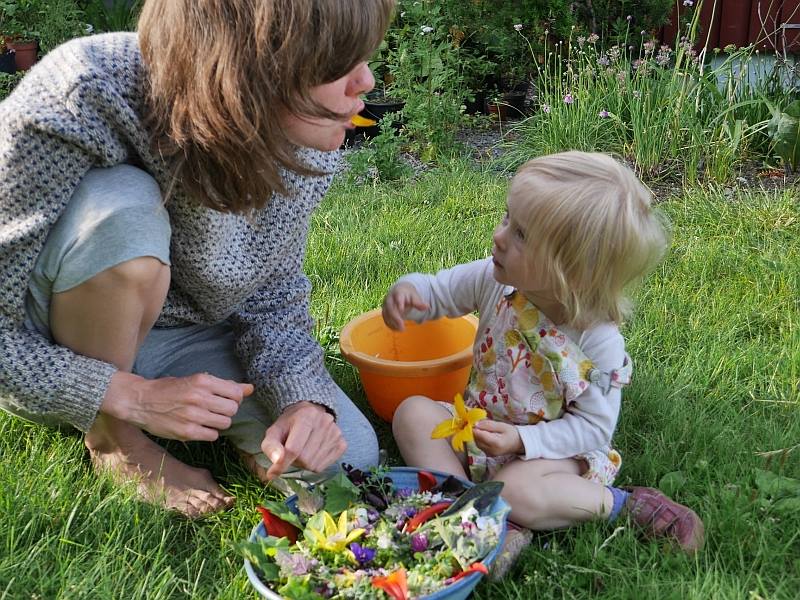
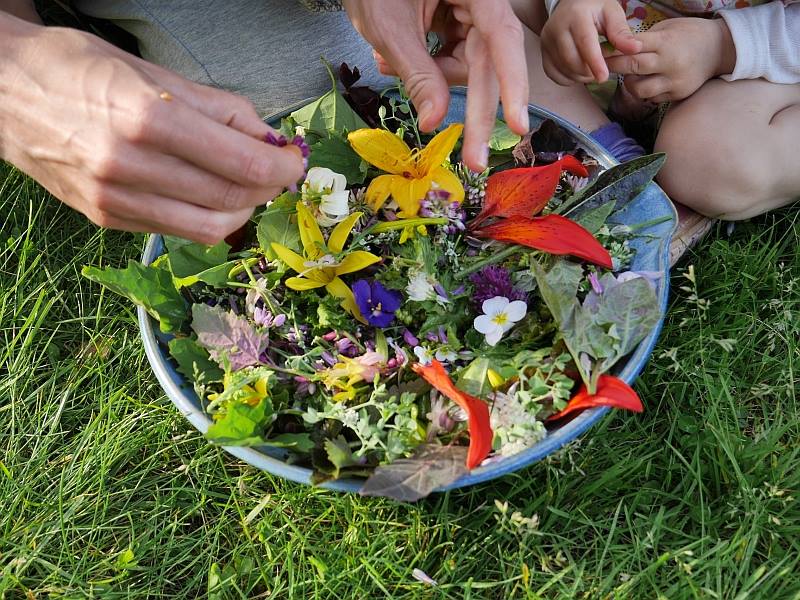
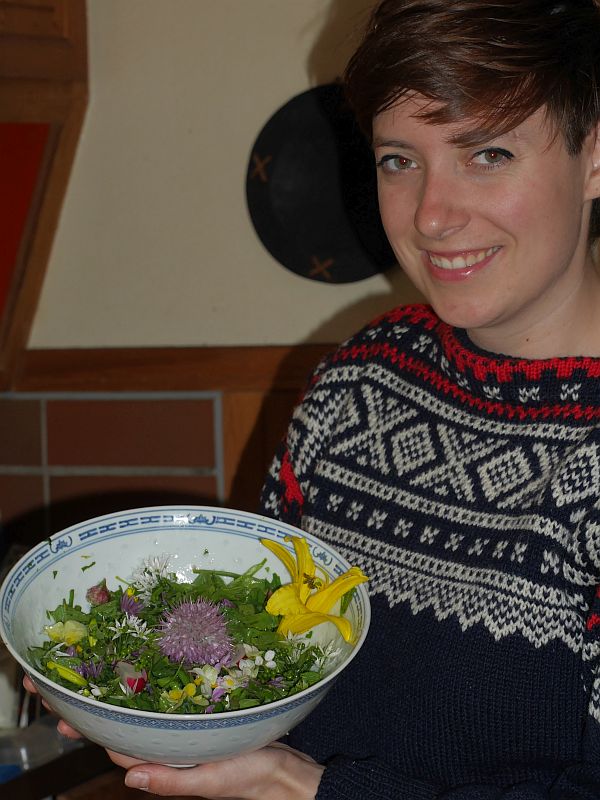
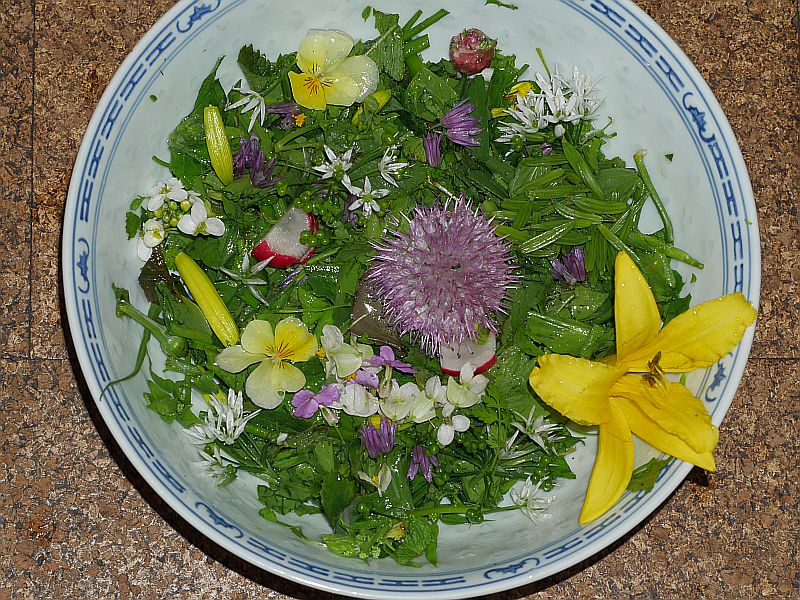
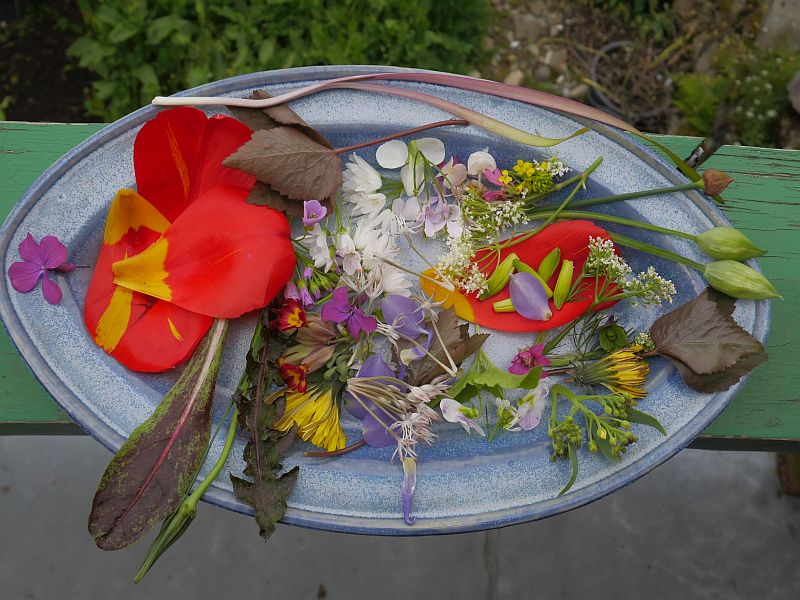
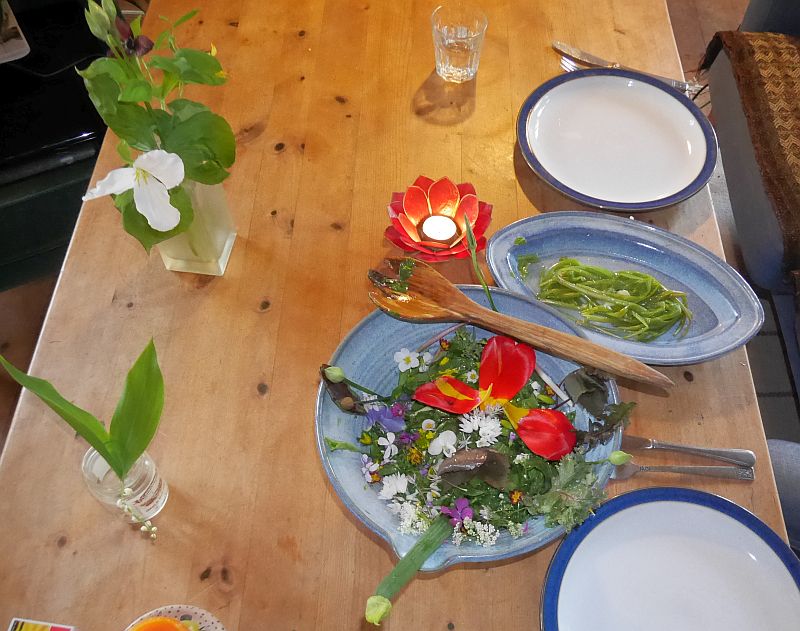
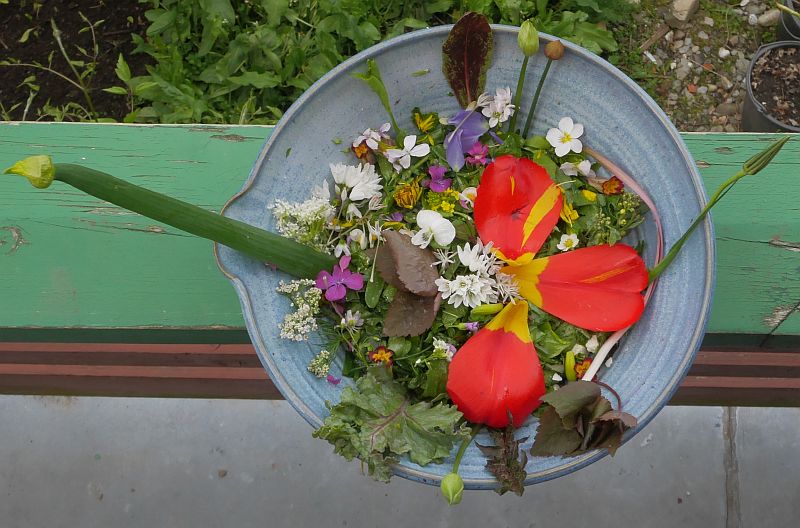
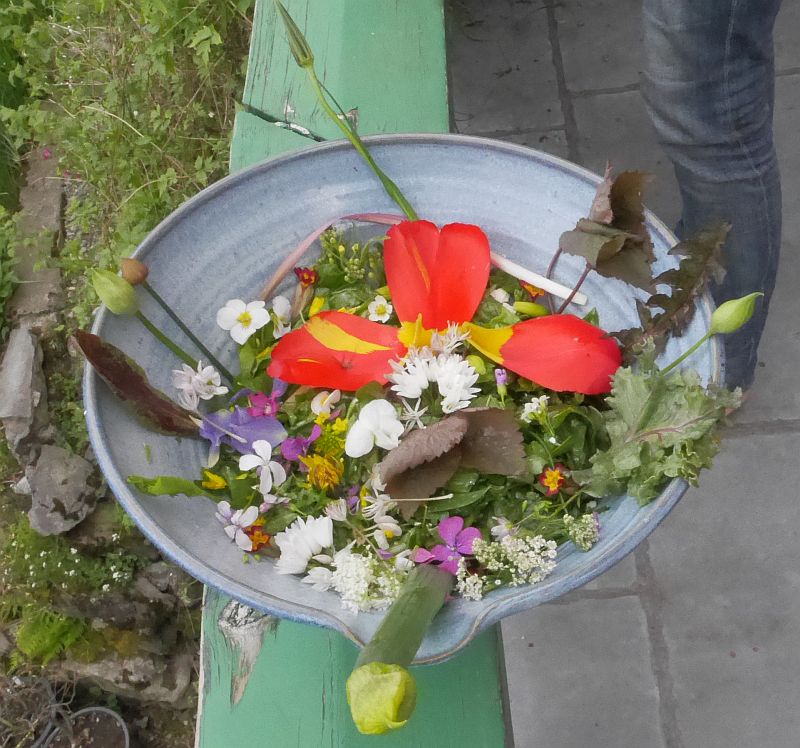
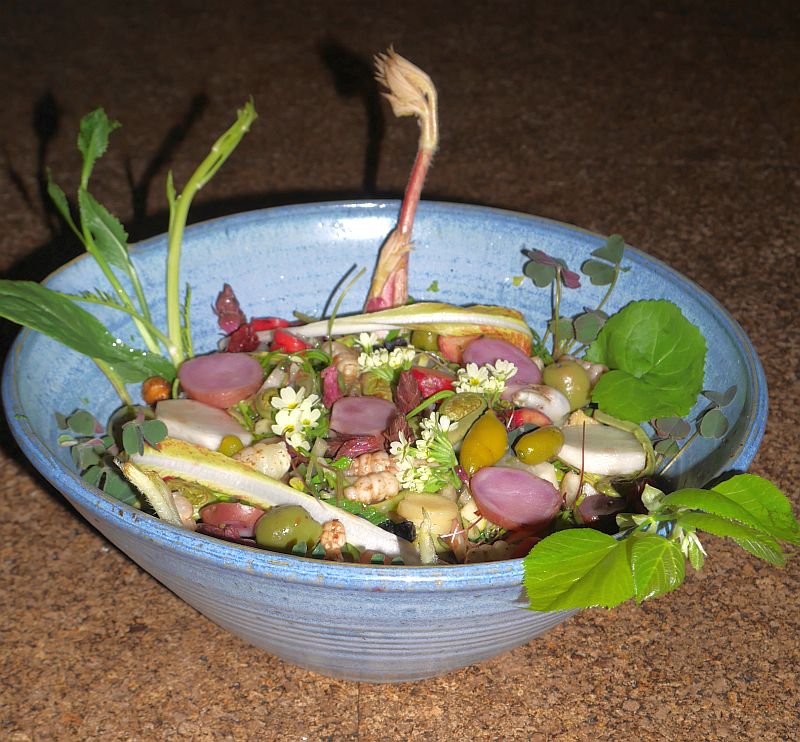
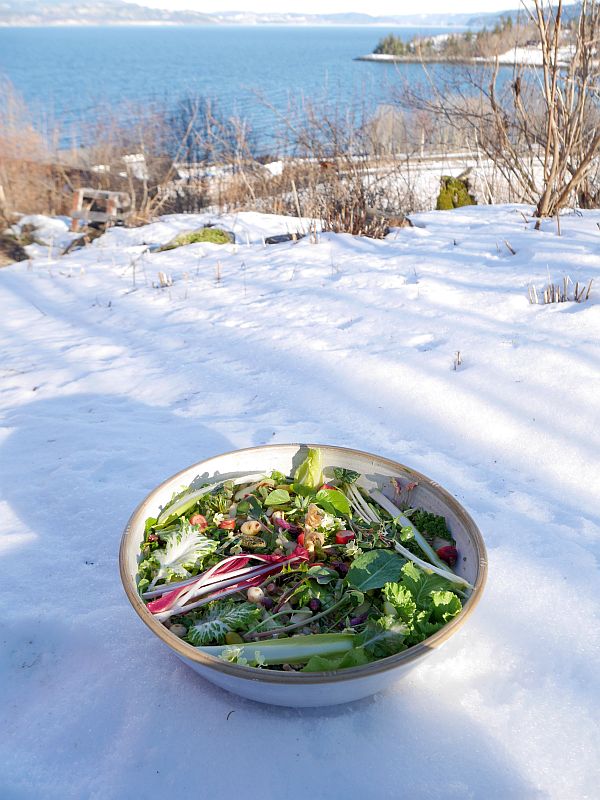
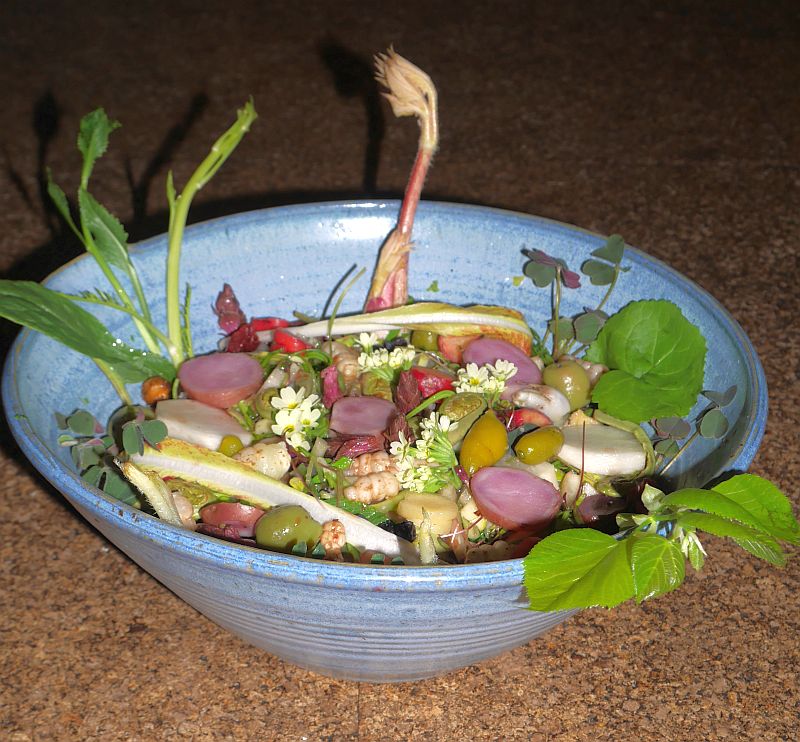
This weekend, I have a film crew in the garden (more later) and a multi-species salad was of course on the agenda. We made this last night and it was served wild salmon that they had brought with them!! The resultant feast can be seen below! Apart from Begonia flowers, Stevia and Cuban oregano, everything is harvested outdoors and almost all are cold hardy perennials! A salad totally free of tomatoes and cucumber!
Yesterday, 19th May 2017, I spent several hours being filmed in the garden collecting and preparing a multi-species salad, predominantly perennials…and this was the result! How many? The recount will take some time….
More later :)
Thanks to Ane Mari Aakernes (camera), ably supported by Berit Børte…
I’m really looking forward to doing 5 events in Austria for seed saver organisation Arche Noah from 11th -17th June! Their latest April magazine contains the following good looking article with, I’m assuming some good words too ;)
I had already agreed in the autumn to take part in the culinary program of this year’s Kosmorama Film Festival in Trondheim in collaboration with the leading restaurant Credo. I therefore made my plans to make a diversity salad back then by moving roots and plants of perennials, that I could force early to be ready to harvest in early March, into my cold cellar. The cellar is basically 4 unheated full size rooms under the house which, in a normal winter, are around 2-4C, perfect for storing vegetables.
I’ve divided the ingredients into 11 groups and each are discussed in turn below. The first group of vegetables were:
1) CELLAR STORED ANNUAL VEGETABLES
These are traditional vegetables, both leafy greens and root crops like potatoes. I transplant all the leafy greens, like swiss chard, kales, leeks, parsley and chicories from the garden to pots and wooden boxes full of soil. If the temperature is below about 4C, most of the vegetables go into a hibernation state and I can continue to harvest them when I need them. As the temperature increases many of the plants sprout and in the dark (it’s not necessary to use lights at all) the young growth lacks chlorophyll (are blanched). Here are a few pictures (the captions tell more):
Chicory “Rossa de Treviso”. The colour doesn’t fade despite it being dark in the cellar
This is a root chicory cultivar “Cicoria di Chiavari”. This winter was exceptionally mild until recently and the roots had sprouted. Both the cooked roots and sprouts were used
Swiss chard…the lighter coloured leaves have grown since planting in the cellar
Swiss chard at the front with chicories behind
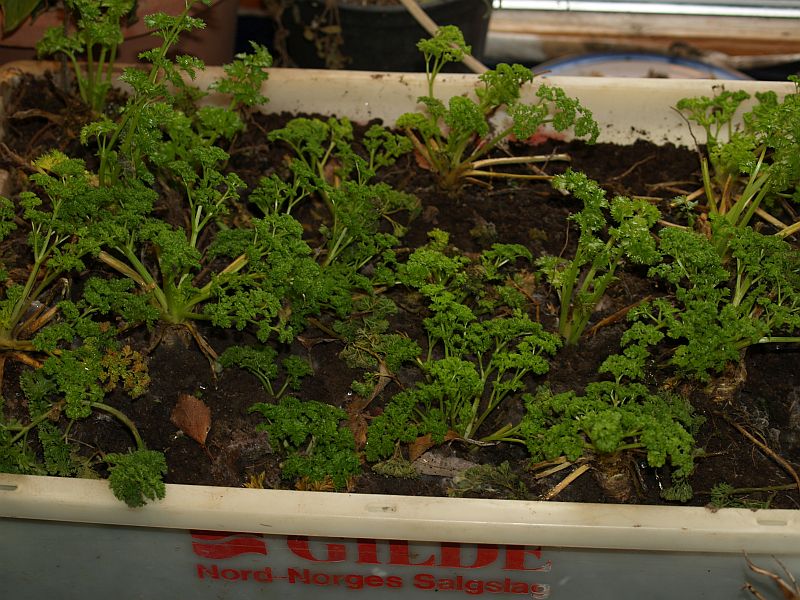
Parsley
Various cellar vegetables including carrots, chicories, parsley, turnip
One of 6 potatoes used in the salads (cooked), this is the red-fleshed variety Highland Red Burgundy
The cooked Highland Reds lost their colour, seen here on the Credo salad
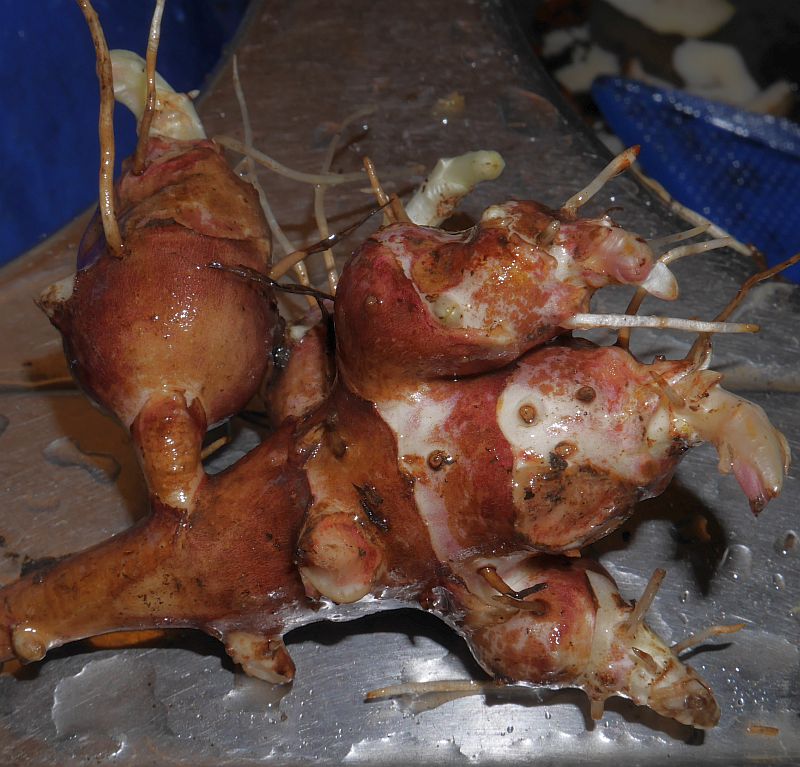
Various varieties of Jerusalem Artichokes were also used…the green sprouts were also used. Other tubers and roots in the salads included burdock, Tragopogon pratensis, carrots, turnips, Cirsium tuberosum, chorogi and skirret
2) PERENNIAL VEGETABLES FORCED IN THE LIVING ROOMS
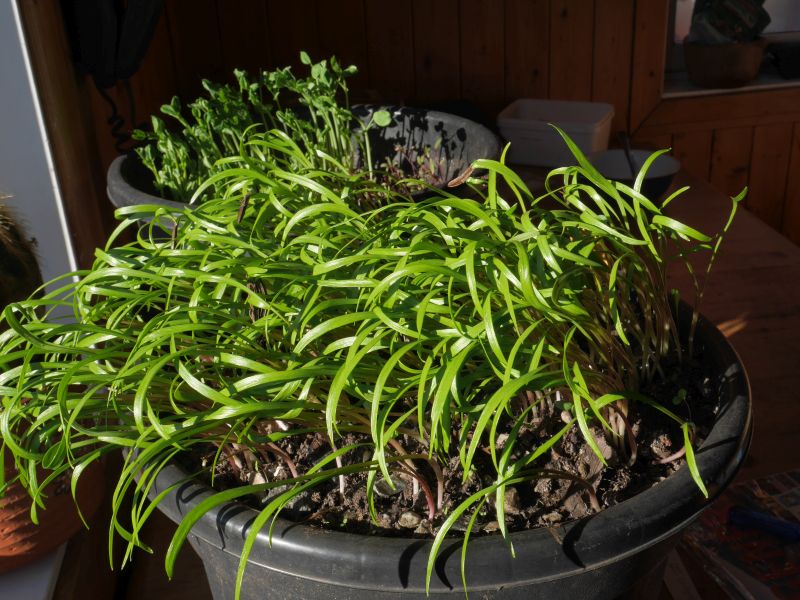
These are mainly roots and tubers of perennial vegetables dug and planted in large pots, most of which were stored in the cellar before being moved and forced in cool or warm rooms in the house to get an earlier harvest…these included Udo or Aralia cordata (the first time I’ve forced this plant, inspired by the underground forcing chambers in Tokyo) and the only flower, oxlip (Primula elatior). Here are some of these (see the captions for more details):
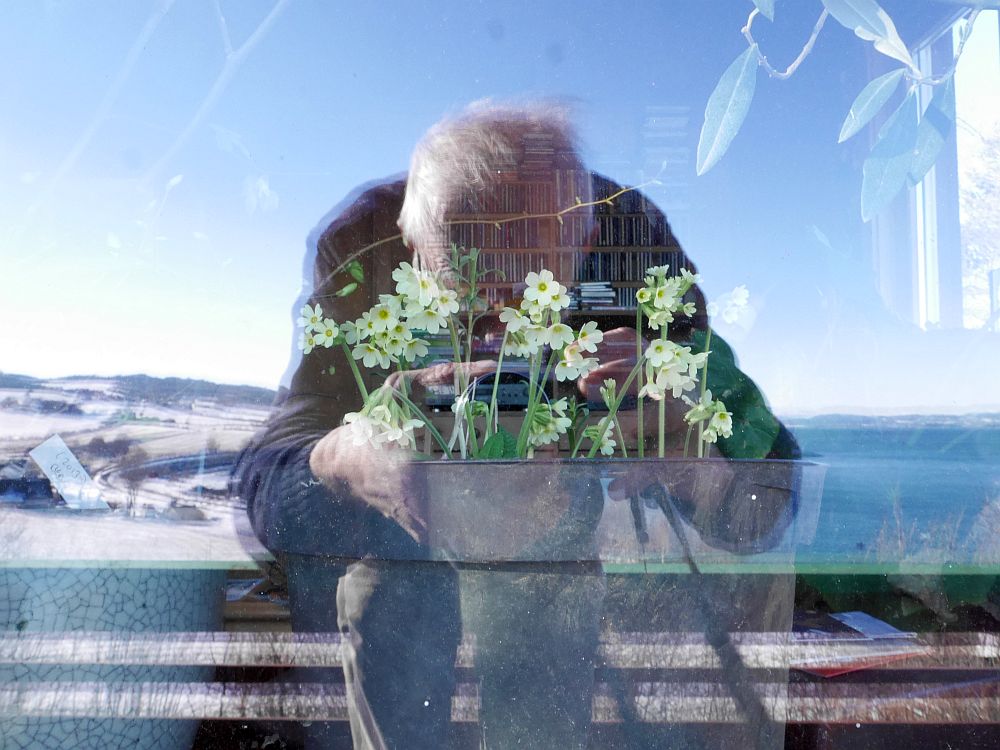
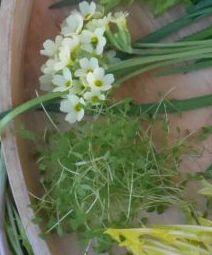
Flowering Primula elatior (oxlip) was teh only flower used…I had also tried Primula veris (cowslip) and Arabis alpina (Alpine rock-cress) but both didn’t emerge in time!
Forcing pots in the living room
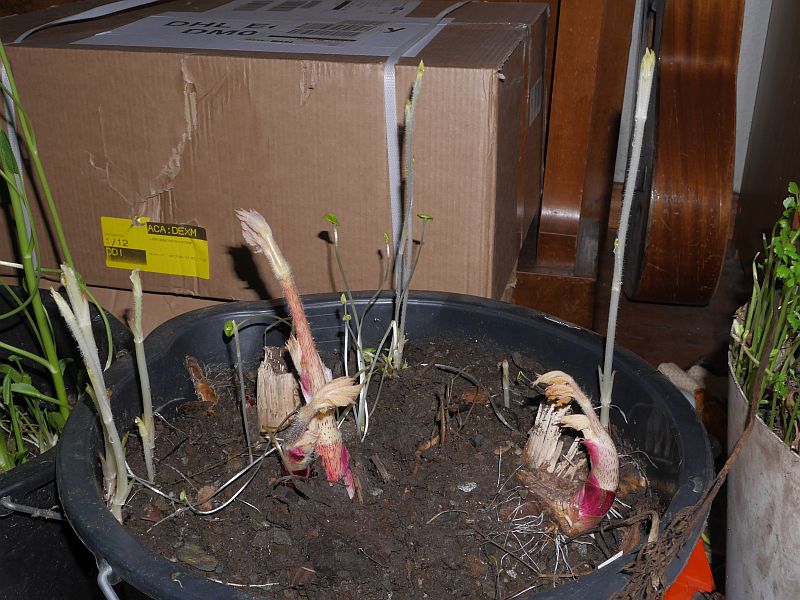
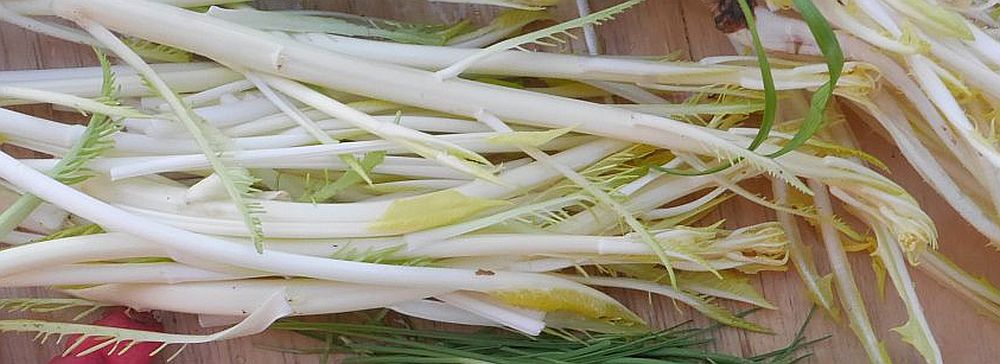
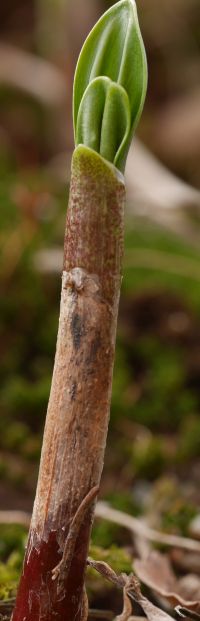
Udo (Aralia cordata) roots were dug in the autumn (see next picture) and were forced in the dark…note also the tall thin white shoots around the outer part…these are also Udo
Udo roots dug in November for forcing
Hablitzia (Caucasian spinach) shoots
Hablitzia (Caucasian spinach) shoots
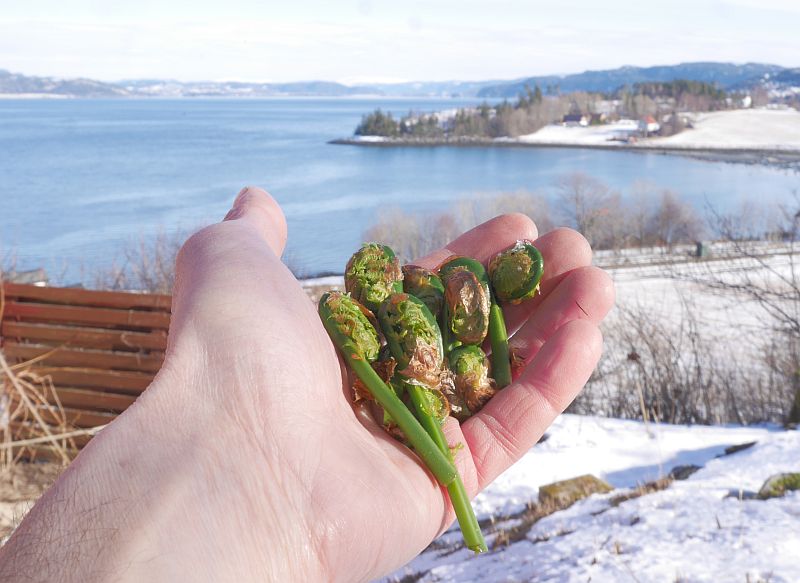
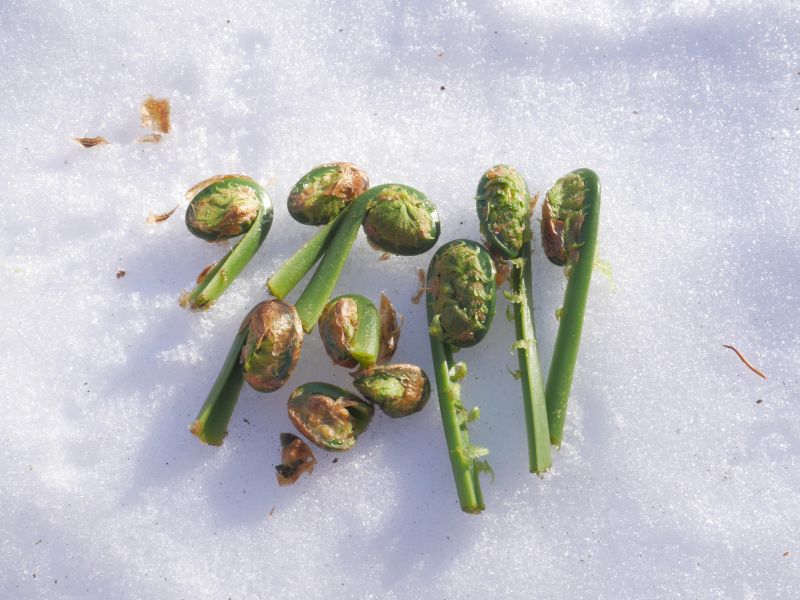
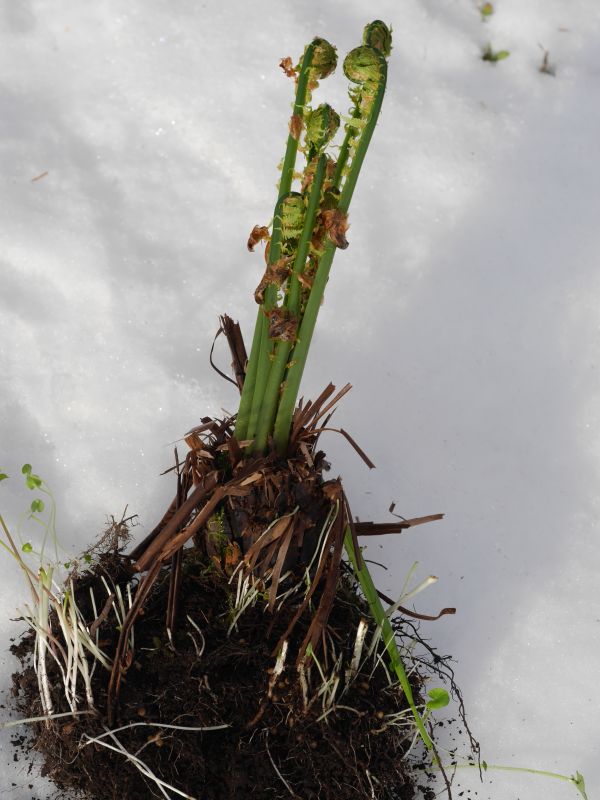
Ostrich Fern
Ostrich Fern
Ostrich Fern – this one grew far too quickly
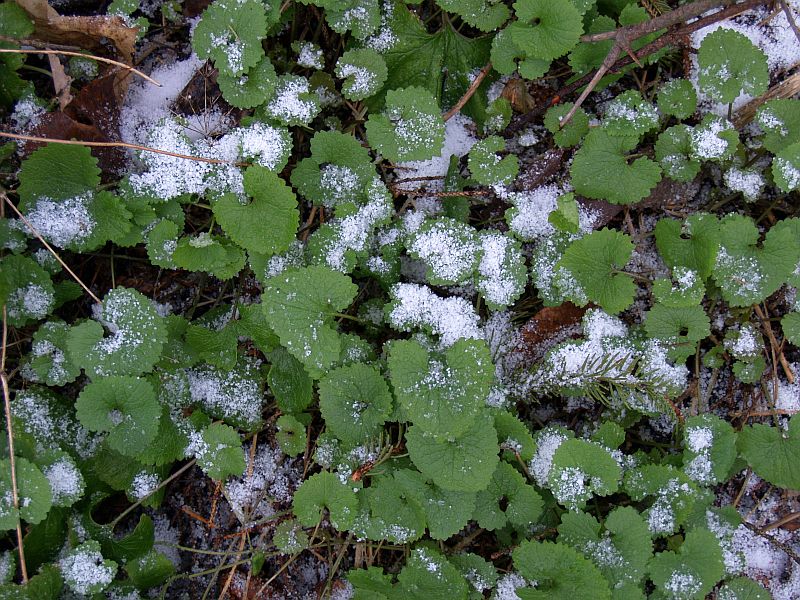
Ground elder (Aegopodium podograria) had followed the Ostrich fern in, so there were a few of these in the salad too
Rumex acetosa, sorrel
Allium senescens or hybrid shoots
A mix in this pot, including Malva moschata (musk mallow), Primula veris, Diplotaxis (perennial rocket) and Arabis alpina
Forced Oca (Oxalis tuberosa) and Jerusalem artichoke
3) PERENNIAL VEGETABLES HARVESTED IN THE CELLAR
These are all perennial plants that continue growing in very low temperatures such as kales, horseradish, dandelion and fool’s watercress, which despite the name IS edible (see the captions for more details):
Perennial kales
Pereennial kale
Horseradish
Wild dandelion
Apium nodiflorum, Fool’s watercress
4) TREE LEAVES FORCED INSIDE
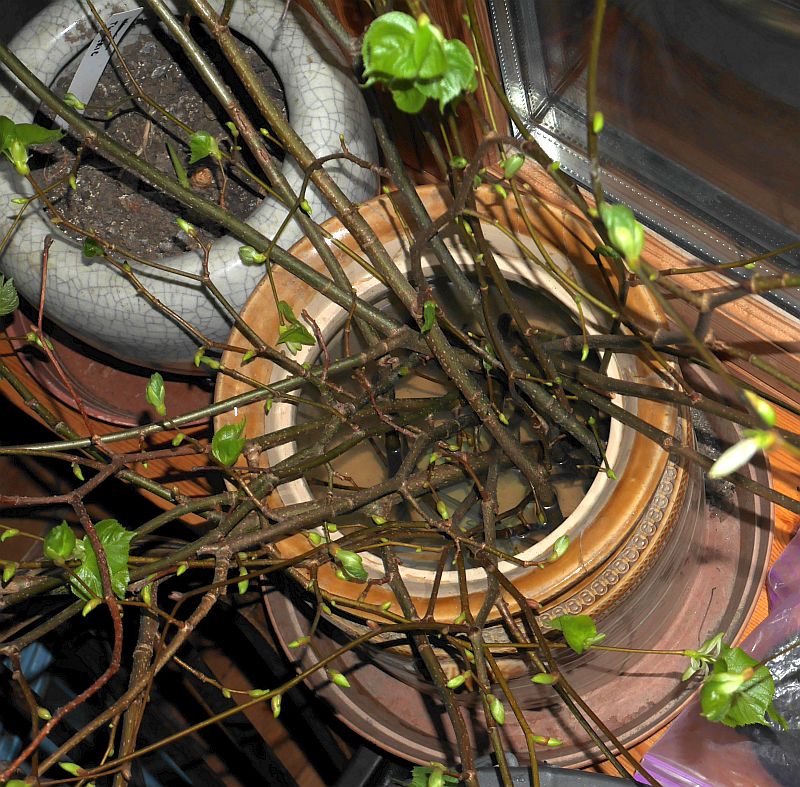
Lime leaves are reckoned by many to be the most tasty tree leaves (at least of common European trees). I have a few trees in the garden, so I cut off a few branches a couple of weeks ago and forced them indoors (with the branches in water)….the leaves appeared just two days before time…
5) SEED SPROUTS
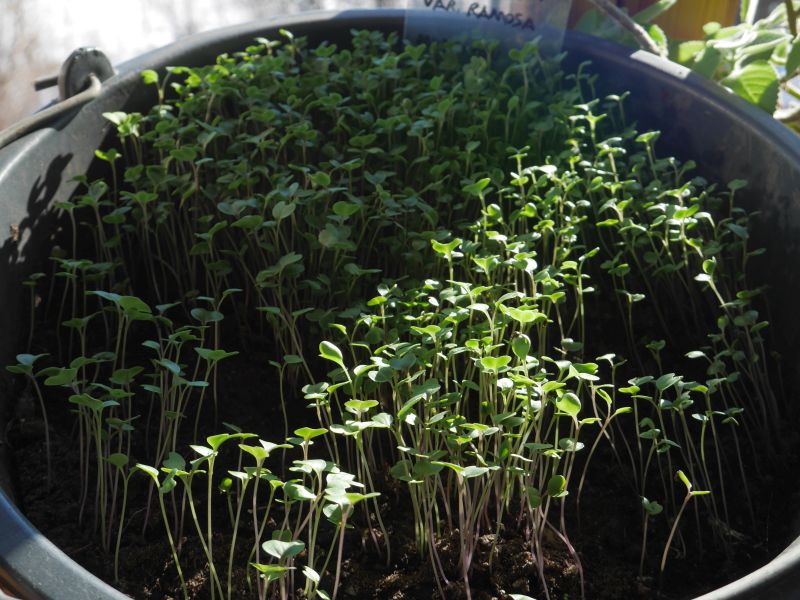
Both seed of annual plants like cress and buckwheat, perennial seed of sweet cicely (stratified / cold treated outside for about 3 months) and bulbils (garlic) were used. All seeds were home grown (see the captions for more details):
Myrrhis odorata, sweet cicely perennial seed sprouts (sowed in autumn, stratified outside for about 3 months and then brought inside to germinate
Myrrhis odorata
Pea shoots with two types of garden orach (Atriplex hortensis) in front
Pea shoots
Japanese radish sprouts
Aleksandra garlic bulbil shoots
Cress (Lepidium sativum)
Wild buckwheat, Fagopyrum tataricum
6) OUTSIDE HARVEST
Despite the cold weather and snow cover, it was possible to locate various plants that had begun shooting under the snow, mostly different Alliums (onions), but also Hablitzia tamnoides (Caucasian spinach) that always begins shooting in the autumn. Another winter annual plant (germinating in the autumn and standing green over winter) harvested was Alliaria petiolata (hedge garlic). Also Scorzonera, Tragopogon, Ragged Jack kale and various dandelion cultivars / species were also harvested outside (see the captions for more details):
Hablitzia shoots
Allium victorialis, a Japanese variety
Allium senescens hybrid
Allium cernuum, nodding onion
Alliaria petiolata, hedge garlic
7) DRIED AND FRESH FRUIT
Apples (variety Aroma) were used fresh, stored in the cellar and a number of dried fruits (soaked in water for a couple of days) were also used. These included sour cherry, plums, apples, saskatoons, raspberry, black raspberry, redcurrant and bilberry.
8) TUBERS STORED IN THE LIVING ROOMS
These are tubers that are stored at higher temperature like oca, ulluco, Madeira vine, achira, Tigridia and yacon:
A selection of Andean tubers including ocas and ullucos
Yacon tuber that had been in the window sill in the living room since harvest
Yacona and various other tubers
9) INSIDE HOUSE “WEEDS”
Chickweed (Stellaria media) was harvested from a pot of chives in the kitchen, one plant of Ligularia fischeri was found growing in a pot with a cactus (seeded from a perennial in the garden) and one Hablitzia plant had seeded itself with a bay tree.
Harvested chickweed with oxlip flowers
10) HOUSE EDIBLES
A few plants are permanent house plants in my living room, including Cuban Oregano, Lippia dulcis (Sweet Aztec Herb), Lemon Grass, fresh Bay Leaf and Sugar Cane. The salad dressing: These flavourings were first boiled with freshly harvested sour tasting seed heads of staghorn sumac (Rhus typhina) and a little dried chili. The remaining concentrated water was mixed with olive oil (not home grown although I do have 3 berries ripening on a small tree!) and crushed garlic to make the dressing. Toasted seeds (see below) were mixed in.
Lemon grass harvested from the living room
I also grow sugar cane, here with lemon grass, bay leaf and Rhus typhina (lemonade bush) seed heads harvested in the garden…boiled and the water used in the dressing
Cuban oregano leaves (Plectranthus amboinicus)
11) SEEDS
The final category is seeds, including seed of opium poppy, caraway, dill and invasive Himalayan balsam (Impatiens glandulifera) which were first fried quickly in olive oil and then added to boiled quinoa (my own selection “Stephe”) and Henry quinoa (seed of Good King Henry)
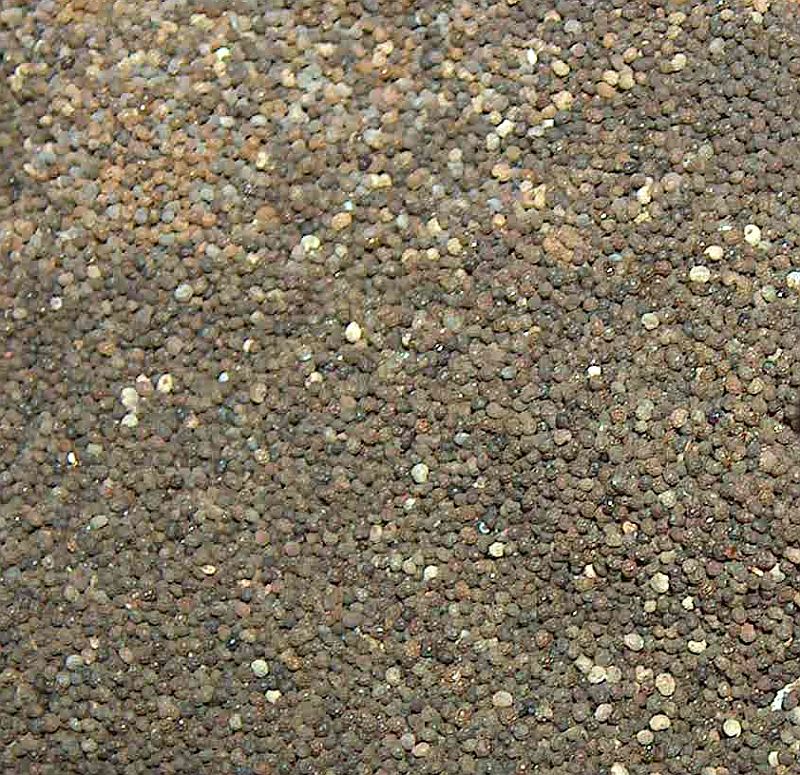
Opium poppy seed
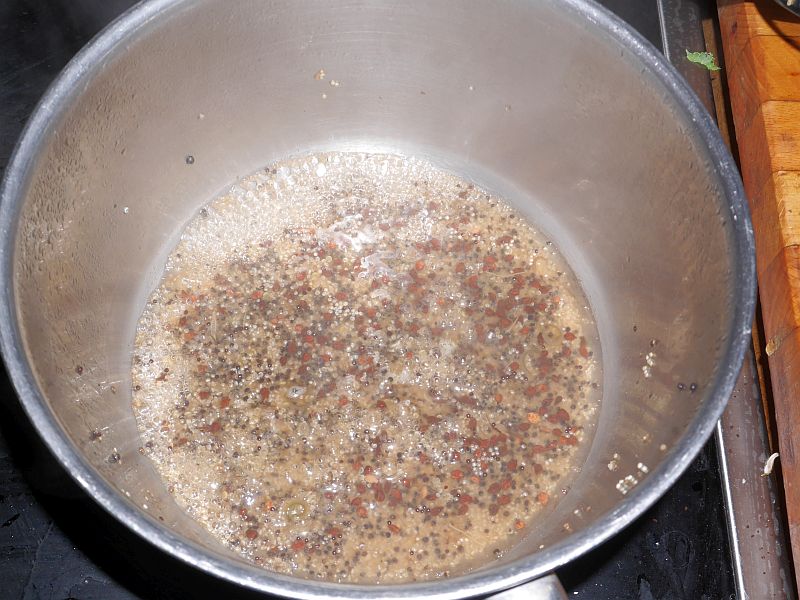
Cooking Quinoa and Henry Quinoa, the seeds of Good King Henry
PREPARING THE SALADS
Preparation is simple.
1) Wash and cut (I use scissors for leafy greens) all the ingredients and put in the serving bowl
2) Put aside interesting and colourful ingredients which can be used to decorate the salad
3) Prepare the dressing
4) Mix the dressing with the quinoa/seed mix
5) Mix the dressing mix into the salad
6) Decorate the salad
Some pictures can be seen below of the salads at different stages of preparation
Preparing the salad: Cooked potatoes with sweet cicely sprouts
Some of the attractive plants to be used to decorate the salad including Udo, Hablitzia, Sorrel, Red Oca leaves, oxlip flowers, lime leaves
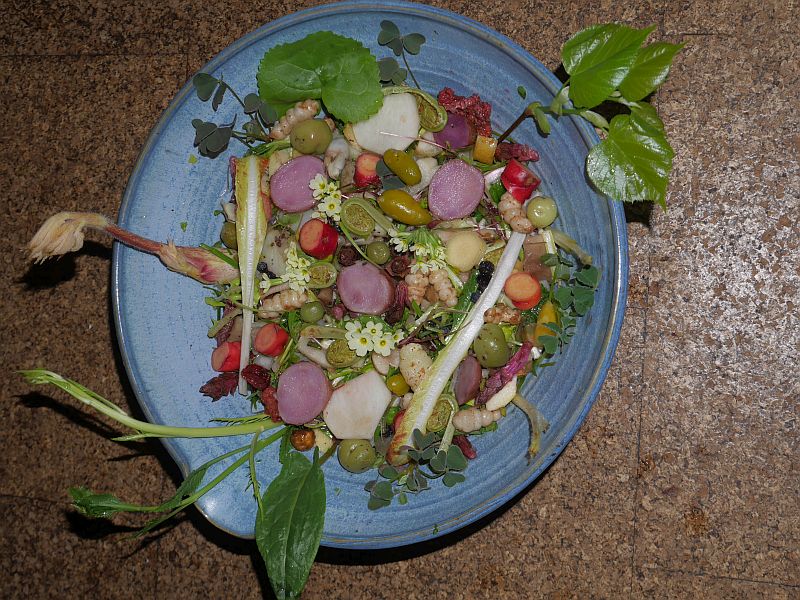
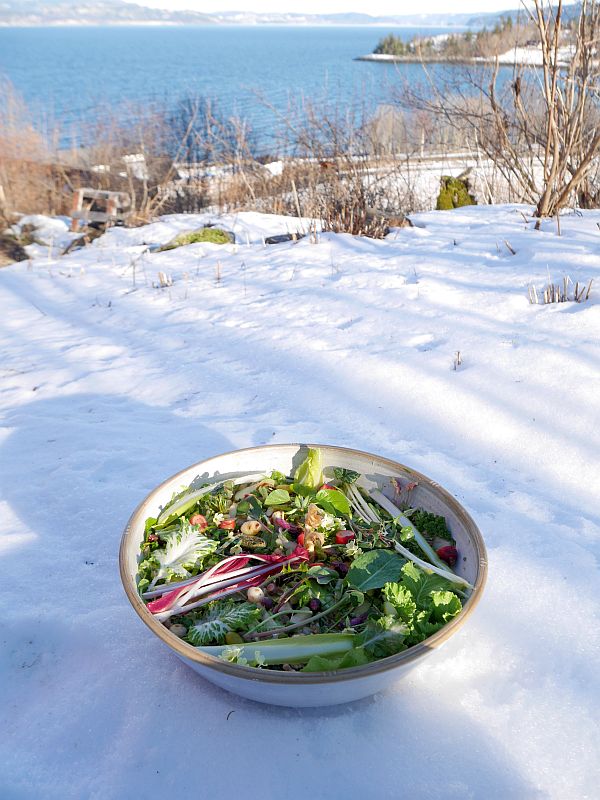
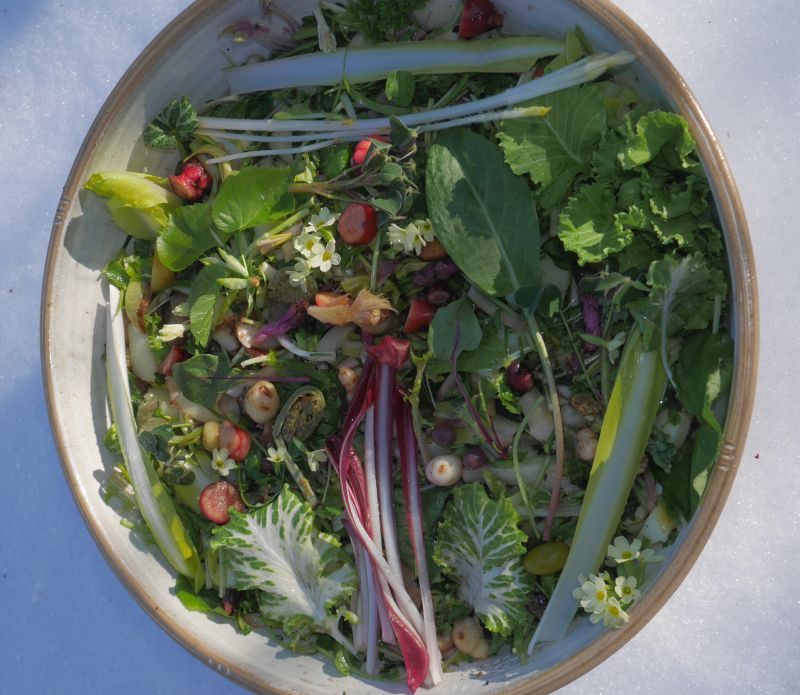
Proof one more time that north is best for growing a diversity of tasty salad greens ;) Presenting (and claiming) my new world winter salad diversity record, a salad with over 140 ingredients all harvested locally without using any additional energy than is available in my house and cellar (no greenhouse; no freezer; no fermenting involved and only dried fruit and seed used apart from fresh vegetables!). Despite the snow cover I was able to harvest some 20-30 edibles outside. More on how this can be done will be the subject of a separate post!
The salad was presented and eagerly devoured by those who had bought tickets for the Gourmet Cinema event on 9th March 2017 as part of the Trondheim Kosmorama Film Festival! It went so quickly, I didn’t even get a taste myself!
The film was followed by a Food talk with a panel including the film’s director Michael Schwarz, the head chef at Credo Heidi Bjerkan, myself and Carl Erik Nielsen Østlund, the owner of the biodynamic organic farm that supplies much of the food to Credo, moderated by Yoshi!
As Michael Pollan concludes in the film: Eat Food, Not too much and (as many as possible) mostly vegetables!
The day before, I had prepared a 105 ingredient salad for the festival dinner at Credo restaurant (http://www.edimentals.com/blog/?p=10184). While preparing that salad, I made a second salad with the same 105 ingredients…and then added almost 40 additional ingredients that I hadn’t had time to harvest the day before!
I also produced this ca.105 ingredients salad for the Credo / Kosmorama diversity dinner last night (8th March 2017), a new winter personal best in winter diversity for me and most of the dinner guests will have doubled their vegetable life lists :)
Another post will show how this is possible so far north with snow on the ground for the last 2 weeks and no use of greenhouse, freezing, fermenting nor extra heat and also discuss some of the plants seen in the picture :)
Norwegian: Med ca 105 ingredienser alle bortsett fra oliven er produsert hjemme i Malvik, ST er min ny vinter rekord i grønnsaks-mangfold :)
I was very pleased earlier in the winter to be asked to take part in the Trondheim Kosmorama Film Festival’s culinary programme, set up around the showing of two food related films:
In connection with both films I am collaborating with Trondheim’s leading restaurant Credo in putting together the most diverse locally-sourced winter food ever in Norway, if not the world…. ;)
After the Michael Pollan film on Thursday 9th March, participants will be able to sample one of my multi-species edimental dishes and other snacks, see a cavalcade of pictures from over 50 of my fantasy salads and other multi-species dishes and there will also be a Food Talk with myself, the film’s producer Michael Schwartz and Credo’s Heidi Bjerkan and local farmer and supplier of gourmet raw ingredients Carl Erik Nielsen Østlund! As Pollan concludes, Eat Food, Not too Much, Mostly (a diversity of) Plants!
After the NOMA film on the day before (Wednesday 8th March), guests can purchase tickets to a dinner at Credo or Jossa Mat og Drikke (upstairs at Credo). The Extreme Salad Man (that’s me!) will be at the Credo dinner and will inform the guests about some of the weird and wonderful veggies from Trøndelag to be included in this 10-12 dish meal. A multi-species dish will also be served at Credo!
All ingredients in my multi-species dishes apart from a simple dressing will be freshly harvested either outside in the garden, from my cold cellar or from living rooms in the house without additional heat, lights nor freezer (no greenhouse). My previous winter diversity records can be seen by following the links below! How many will it be this time? ;)
30th March 2014 (81) Salad http://www.edimentals.com/blog/?page_id=4064