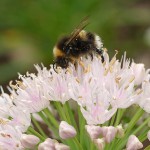
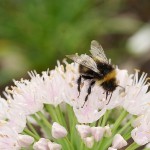
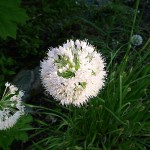
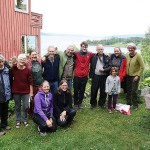
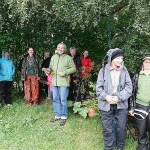
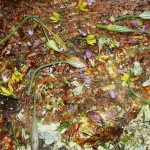
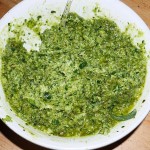
Here are a few of my Allium victorialis pictures from the 2014 onion safari to the Lofoten Islands! The aim was to see the naturalised stands of viking onion / seiersløk on the island Vestvågøy, quite possibly a viking introduction…it grows commonly around the Borg viking museum (on the site of an old viking settlement)…much more in my book on this amazingly tasty, healthy, shade-tolerant and productive onion!
Reconstructed viking onion garden with Allium victorialis and Allium schoenoprasum subsp sibiricum (at the Lofotr Viking Museum at Borg)
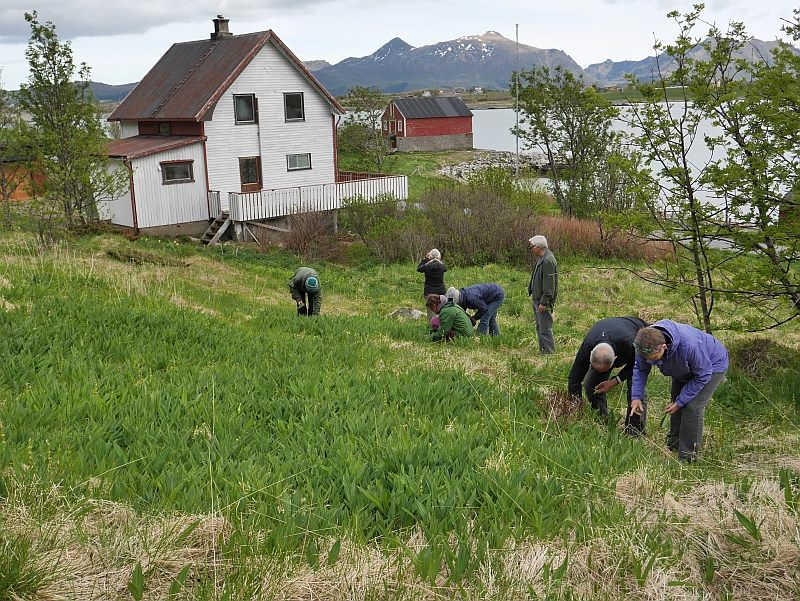
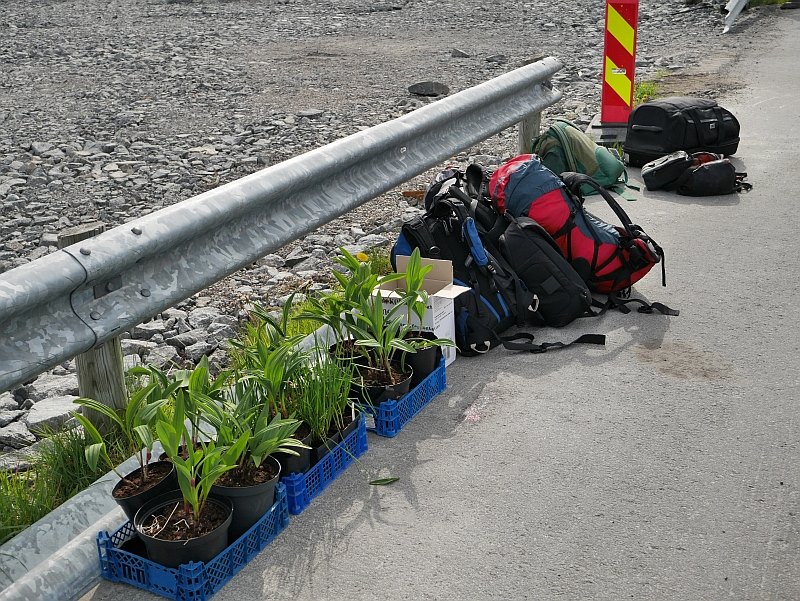
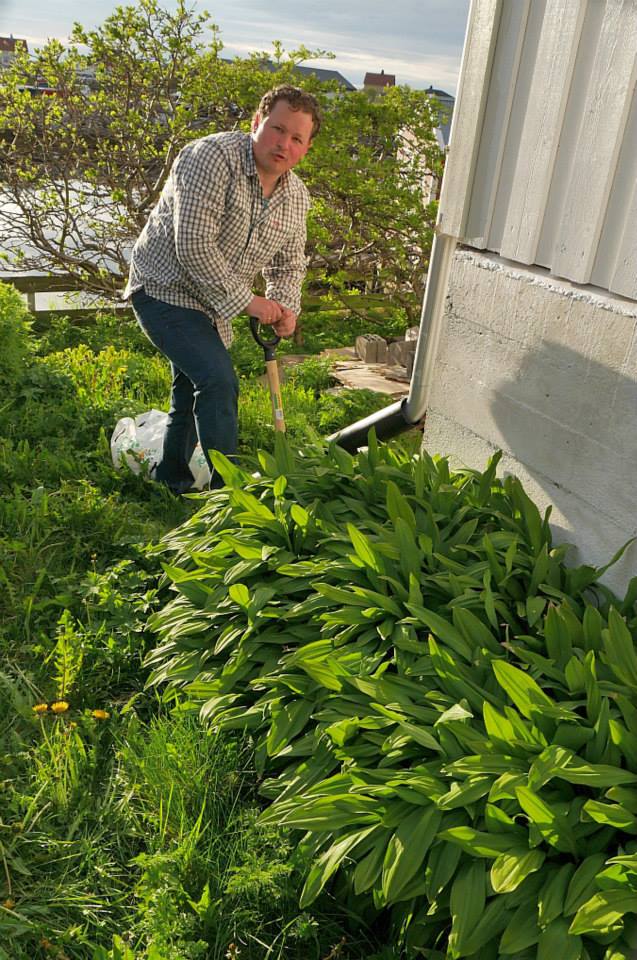
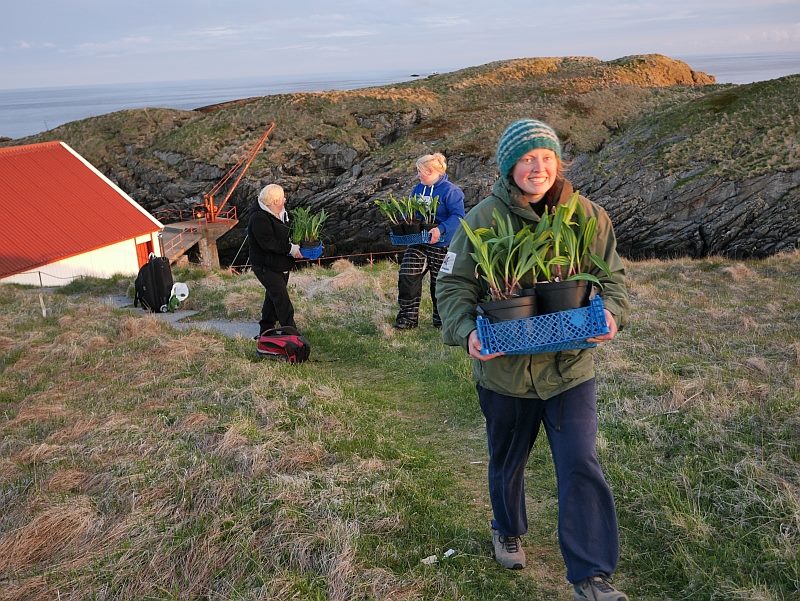
Large patch of Allium victorialis…amazingly, when I posted this the first time, it turned out that one of my FB friends’ mother had lived in this house until last year :)Allium victorialis waiting for the ferry to Røst…purchased at Judiths Urtehage ( a small nursery)On Røst, Einar Stamnes had tipped me of a large patch of Allium victorialis in a garden, possibly 100 years old…This picture was by print screen on the train on the way to the Lofoten Islands using Google Street View….I revisited a garden where I had found an allée of Allium victorialis along the driveway :) Amazing what you can do with modern technology…Onions arriving at our final destination, Skomvær…
The document below is in Norwegian but contains many pictures from my first visit to Vestvågøy in the Lofoten Islands to see the stands of naturalised victory onion (seiersløk), Allium victorialis, including a harvesting trip with Judith van Koesveld (she and her partner Christoph produce a local pesto from the plants). The document also contains an account of a visit to Brynhild Mørkved at the botanical gardens in Tromsø to see the collection of Allium victorialis accessions from different parts of this onion’s extensive range (from the Pyrenees to Japan). Plants vary quite a lot in their form. Finally, I visited Geir Flatabø in Ulvik (Hardanger) in south west Norway and he showed me the large naturalised stand of this plant next to the Granvin river. There are also a few pictures from a collection of heritage ornamentals at the Lofotmuseet and from a visit to a once great but now derelict garden at Finneset (Steinhagen). All pictures were taken in June 2009.
A couple of weeks ago, I finally got round to inviting botanist Kamal Acharya and his wife Sharmila Phuyal to see my garden!! They were amazed to see so many plants that they were familiar with from home and I blogged about this here:
They asked (begged?) couldn’t we come and make you a Nepalese meal with plants from your garden! I just had to find time for this and I’m very glad I did as it was a fantstic meal. Yes, I’m a very lucky man!!
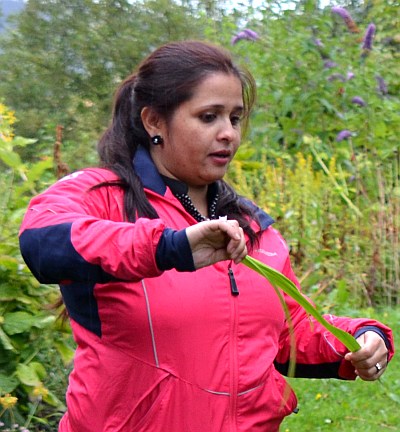
Sharmila about to prepare fresh Jimmu for the very first time. Living in the lowlands, they can only get it dried…
Sharmila gets acquainted with the Nepalese onion in Malvik…still a bit in disbelief that this is really happening!
Another plant my new friends recognised was taro (karkalo) or Colocasia esculenta. I’ve grown this as a pot plant for several years for a couple of tubers a year, inside in winter and outside for most of the summer. Even in our cold climate it grows outside in summer! However, I’d never used the leaves as I thought one had to use special low-oxalate varieties (oxalate in the leaves can scratch your throat). They assured me I could eat it!
Sharmila can’t get karkalo leaf in Trondheim and , so it was amazing for them to meet someone up in the north actually growing it! They will now grow it themselves!
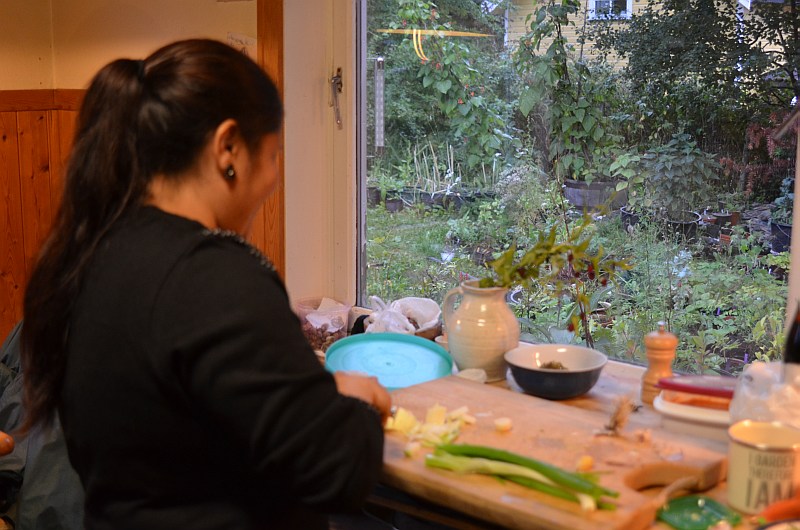
Meanwhile, Britt-Arnhild and helper made the salad (NB! Salads aren’t very common in Nepal, perhaps cooking to sterilise).
What a lucky man I am!!!
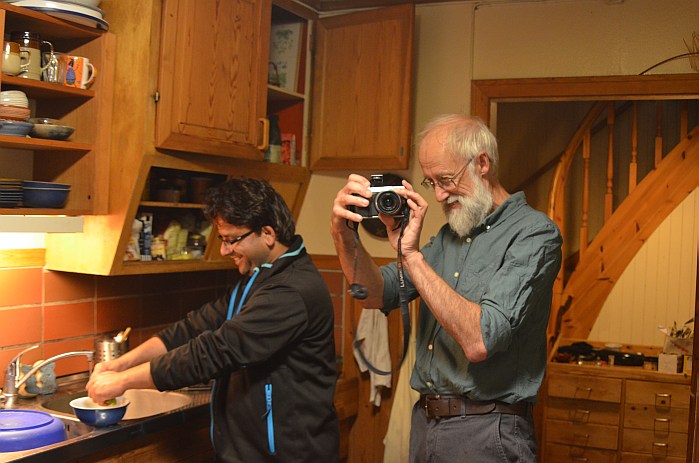
Britt-Arnild’s picture from the kitchen
A quick fry of the Jimmu (Allium wallichii) before adding to the black lentils/dal..
The karkalo leaf stems were first split lengthwise
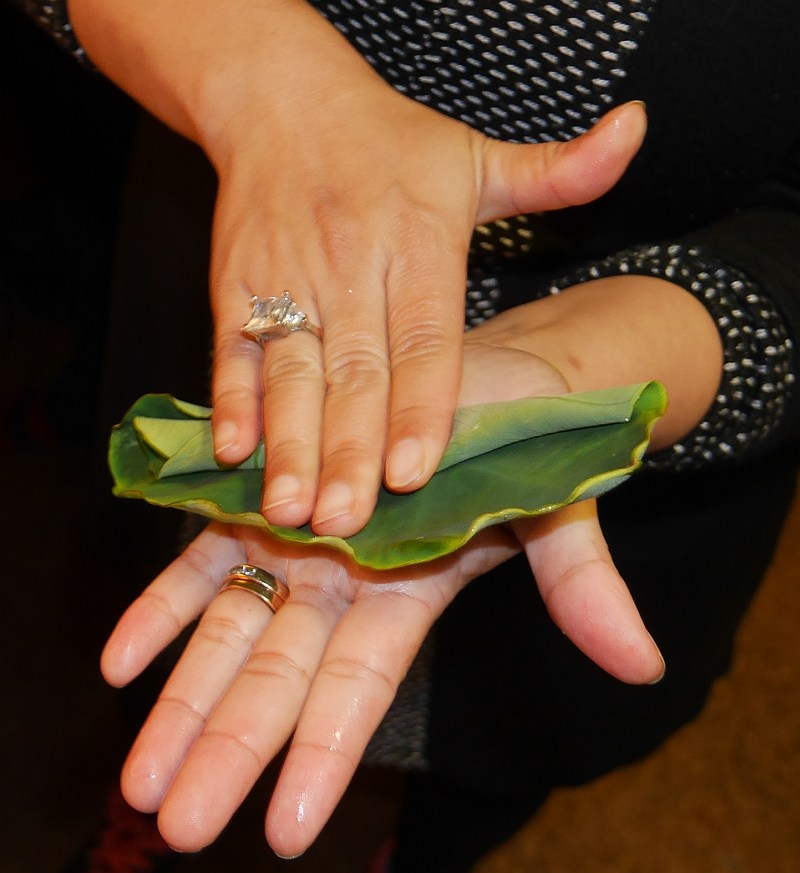
The taro leaf was rolled up before cooking…Sharmila and Kamal had different ways of doing this from their different villages.
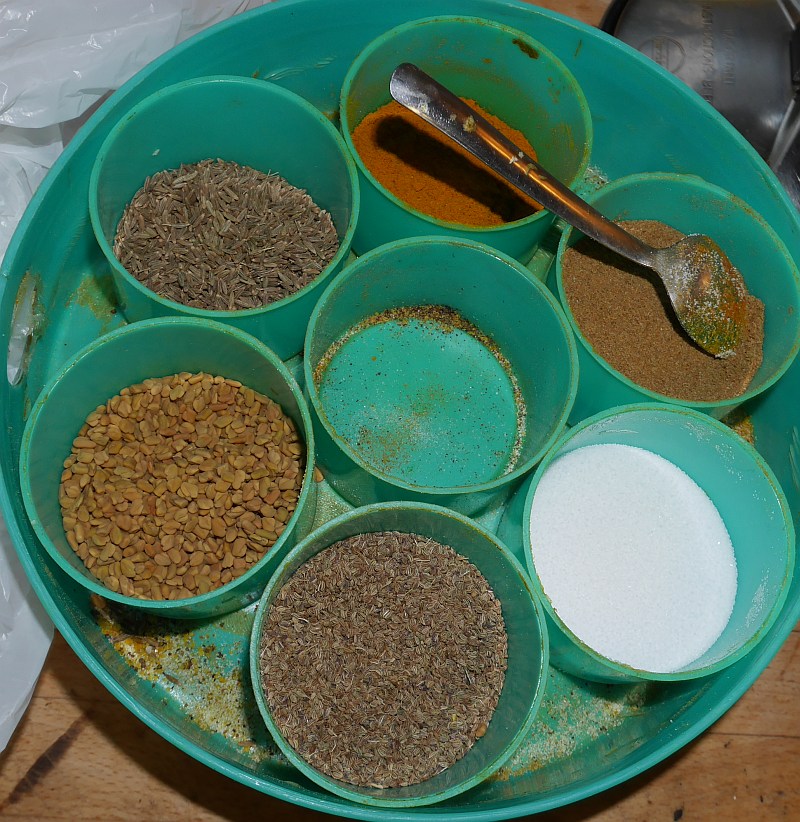
A Nepalese spice colelction including cumin and fenugreek
Cutting the taro leaf
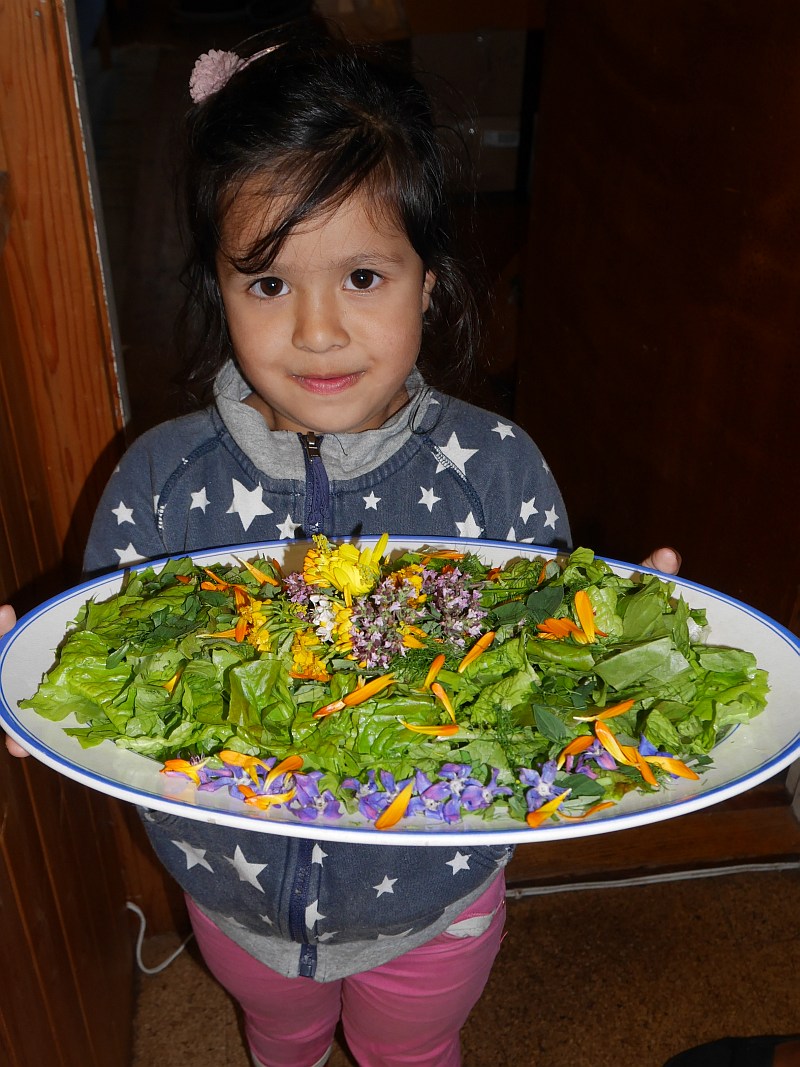
The next generation of edimental salad makers! She decorated it herself!!
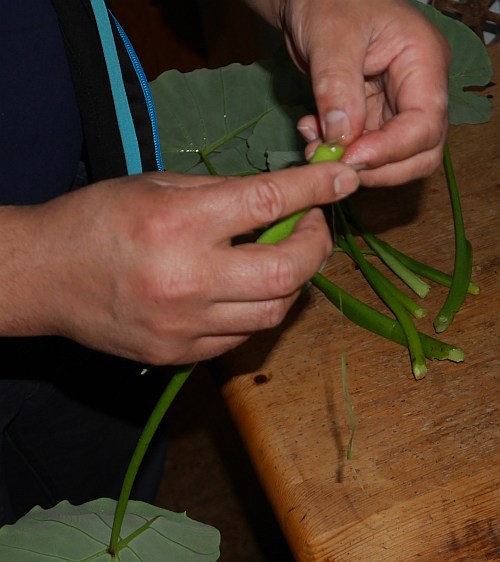
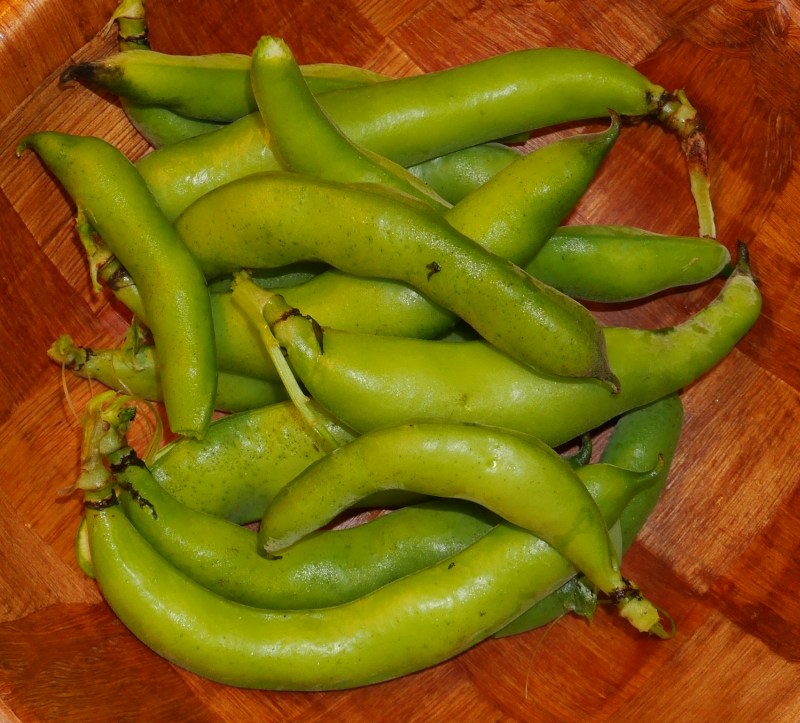
“We use the broad bean pods too” Kamal told me!!! What? Really? Isn’t it very fibrous?
Preparing the broad beans for cooking
The red coloured variety is Karmazyn
The Nepalese pressure cooker was frequently used!
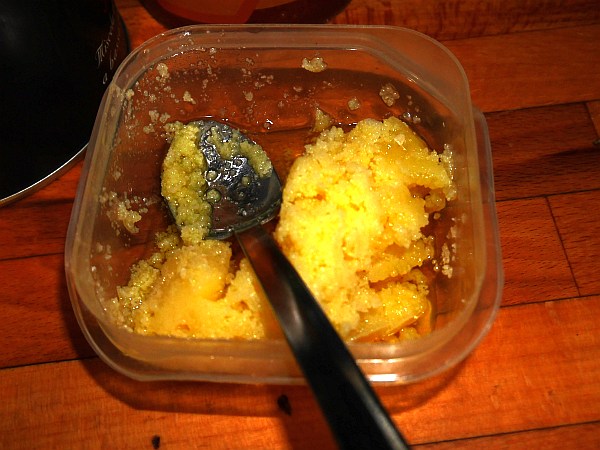
Ghee (clarified butter) is important in Nepalese cooking as it is in India. They sometimes make their own, but this was bought..
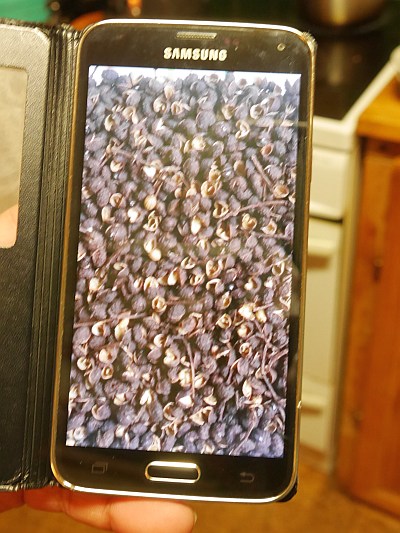
Kamal showing one of the spices used…Zanthoxylum armatum, a new species for my life list!!
Cooking the taro leaf
WOW, are you jealous? The Allium wallichii flowers was a last minute finishing touch…I sacrificed my only dark flowered Jimmu for this picture! The broad beans were a bit fibrous but very tasty…. I will certainly be using the pods of broad beans in future. As Kamal said ” what’s a bit of fibre…it’s good for us!”
Nepal in Malvik edimentalised with the flowers of two varieties of Allium wallichii from high elevations in Nepal, but feeling quite at home in the lowlands of Malvik! The cooked taro was delicious and I will have to start growing more pots of taro as it makes an excellent winter house plant green! I couldn’t sense any silicates in my throat either!
Thanks to Lieven David for attracting my attention to the following interesting paper on “Wild Allium species (Alliaceae) used in folk medicine of Tajikistan and Uzbekistan” https://ethnobiomed.biomedcentral.com/articles/10.1186/1746-4269-2-18 I was particularly interested to read of the use of the young leaves of Allium rosenbachianum, a species commonly sold as an ornamental. I’ve been growing a white flowered form for a few years, but hadn’t come across its traditional use before!
The young fresh or dried leaves are used of A. rosenbachianum and closely related A. rosenorum for the national soup dishes ‘atolla’ and ‘oshi sioalaf’.
Strap-like leaves in spring
An orange tip butterfly on the emerging inflorescence
An orange tip butterfly on the emerging inflorescence
This is what my new friends from Nepal called Allium wallichii, also known as Jimbu, Dunda, Yang, Himalayan onion, Nepal onion or Sherpa onion! They had actually never seen it live before as it grows at high altitudes :)
This is a little album showing off the wide range of forms I’m growing.. one of my favourite edimentals (edible ornamentals).
I wonder if a white form exists?
“Dark form” – this one flowers later than the others, so this is an old picture!
A lovely visit this evening from botanist Kamal Acharya and his wife Sharmila Phuyal and daughter. They taught me several new uses for my old plants!
For instance, we started indoors as it was pouring with rain outside and they noticed I was growing Andean vegetable Cyclanthera pedata (Achocha) in my living room and to my surprise told me it was commonly grown in Nepal and they not only used the small green fruits, but the top shoots and the black seeds. The latter are roasted, ground and mixed with salt, chili and perhaps lemon. The powder is also used as a flavouring in chutney :)
I enjoyed your visit! Welcome back another time when it’s not pouring with rain :)
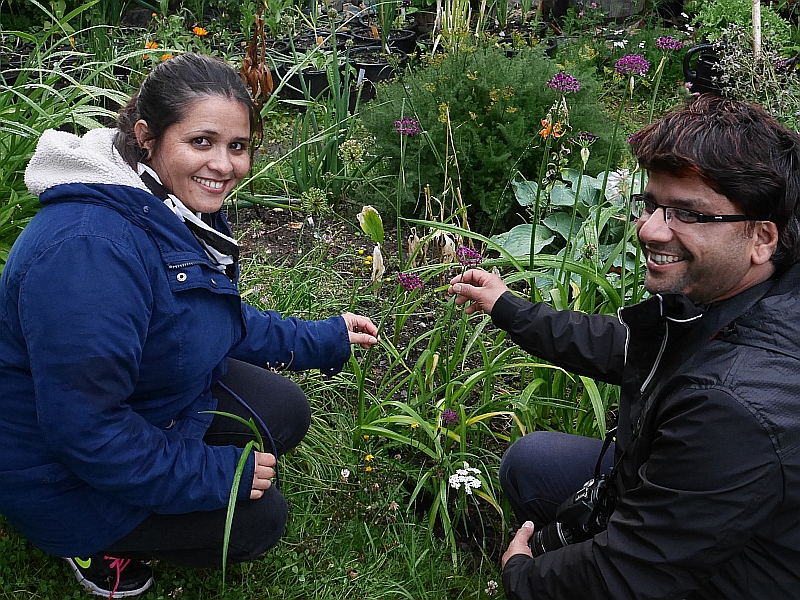
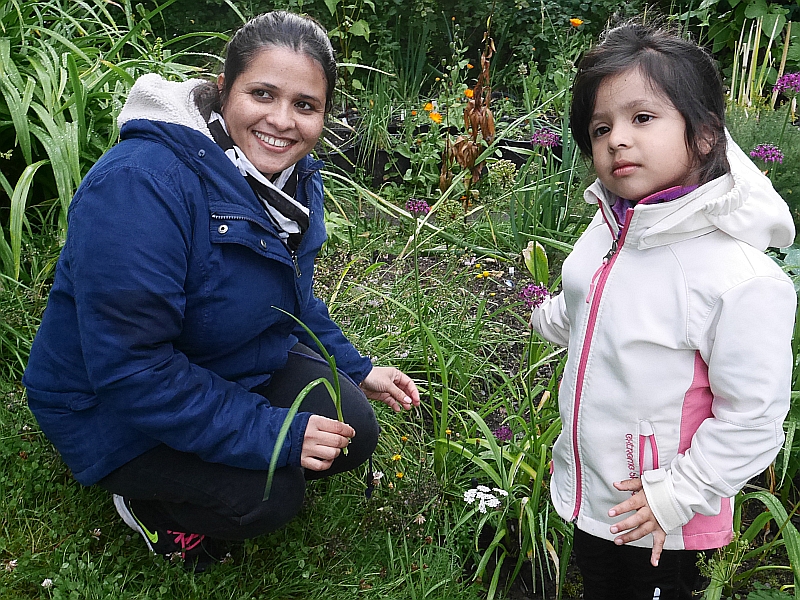
Kamal and Sharmila posing with Nepalese onion, Allium wallichii, one of the 80 in my book :)Sharmila and daughter posing with Nepalese onion, Allium wallichii, best I learned eaten with black lentils…Sharmila showing how she sucked nectar from Canna flowers as a child…:)Cyclanthera pedata (barela in Nepal), my living room climber just coming into flower. This Andean plant has been adopted by the Nepalese :) This is what I grew as Cyclanthera brachystachya “Fat Baby” in my old cold greenhouse in 2008. The picture was taken on 28th September.
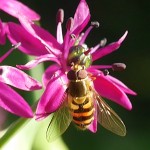
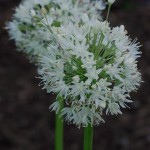
My favourite Himalayan onion is now coming into flower in the garden. This is what I call Sherpa onion (Allium wallichii), it’s a beauty and the bees and hoverflies also love it! The other two pictures are of Norrland onion which has been in bloom for a while now. Both are described in my book Around the World in 80 plants!
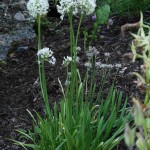
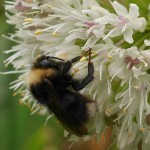
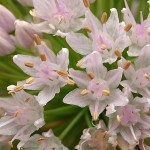
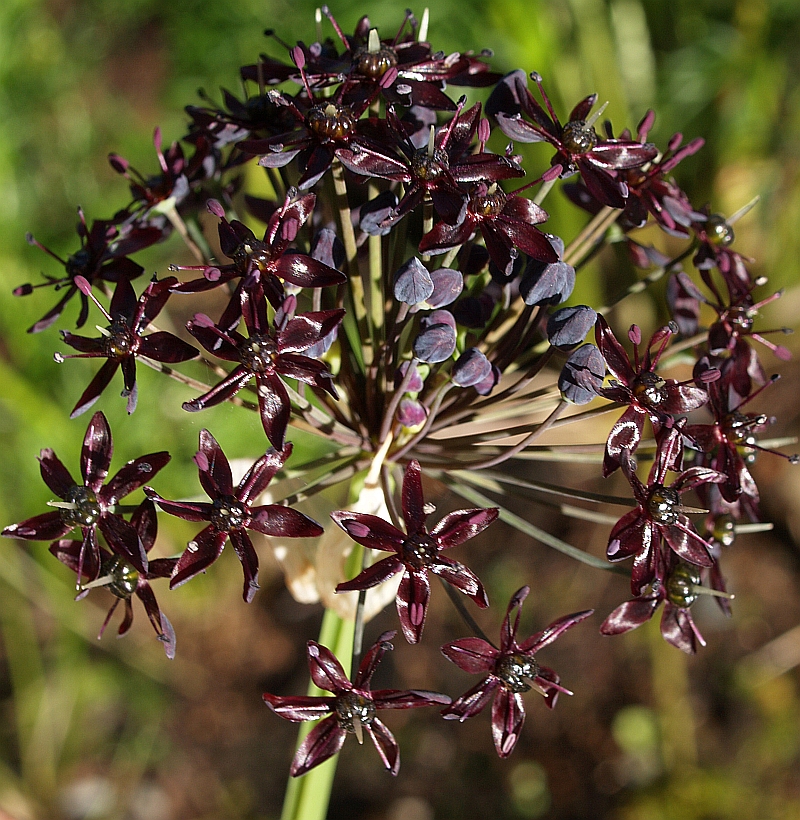
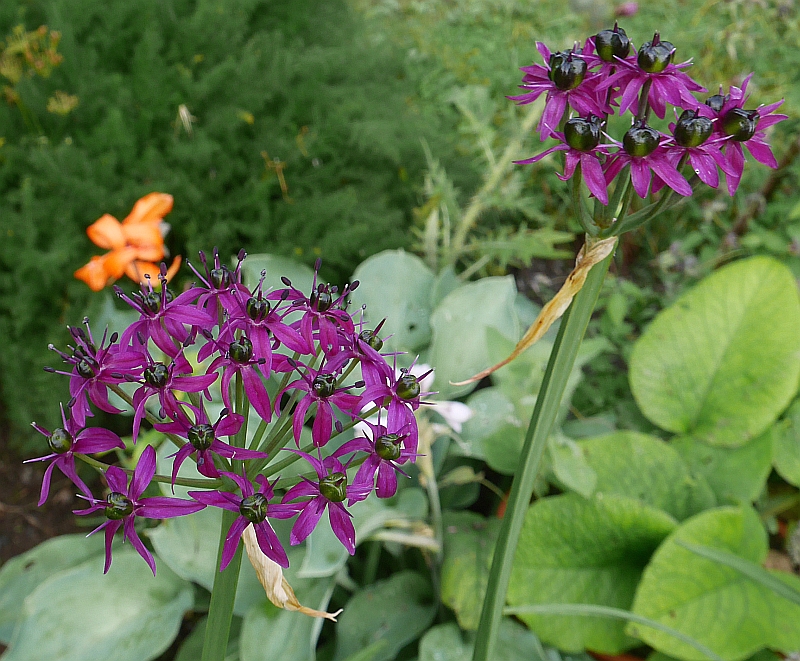
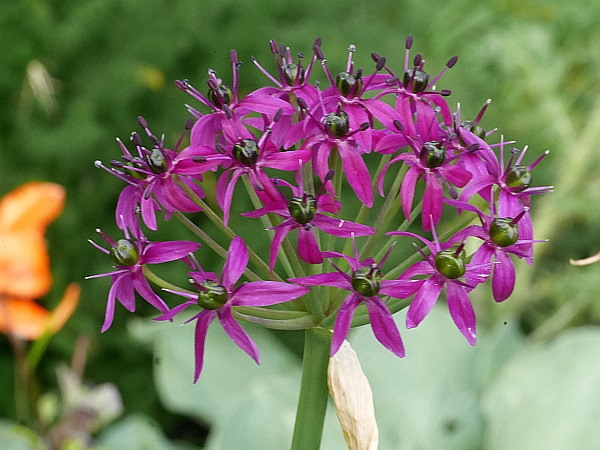
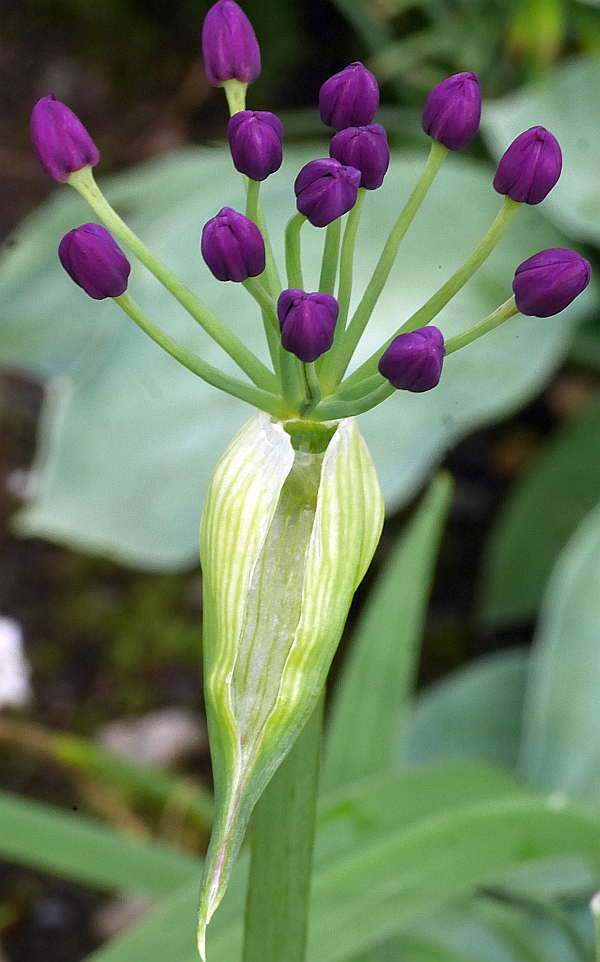
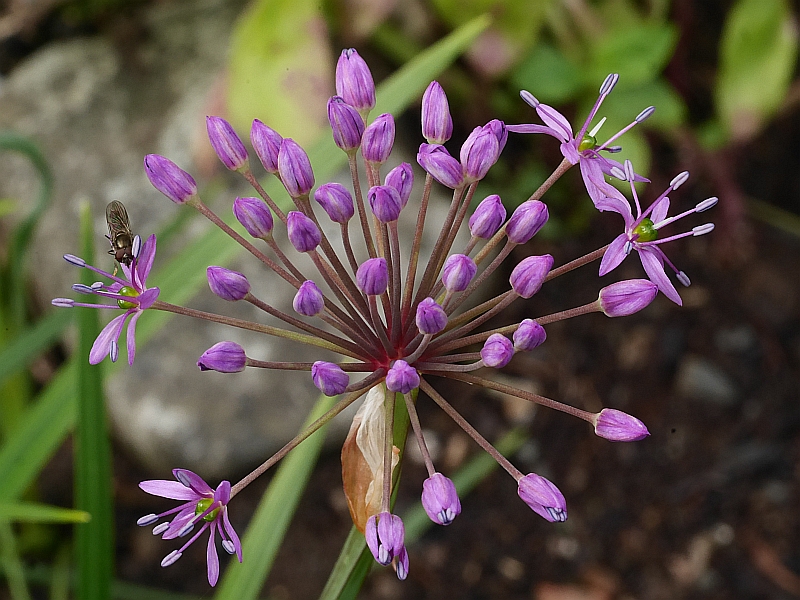
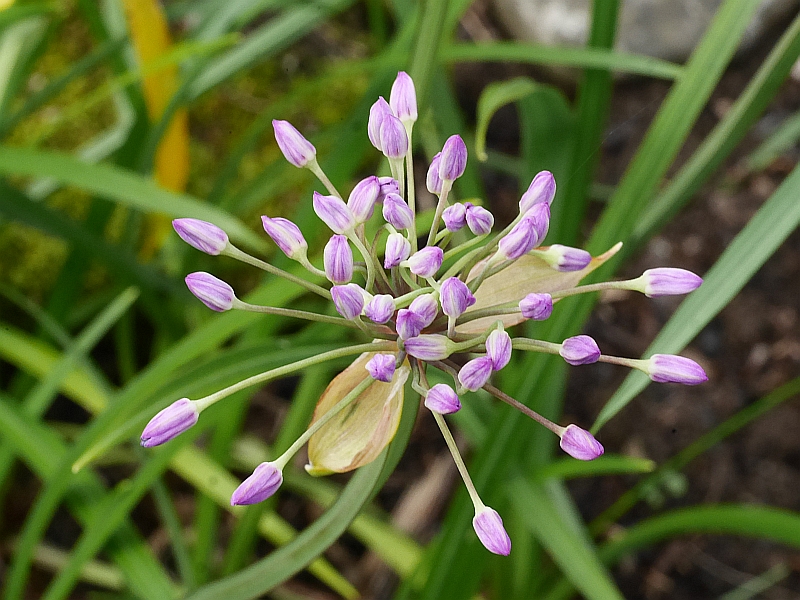
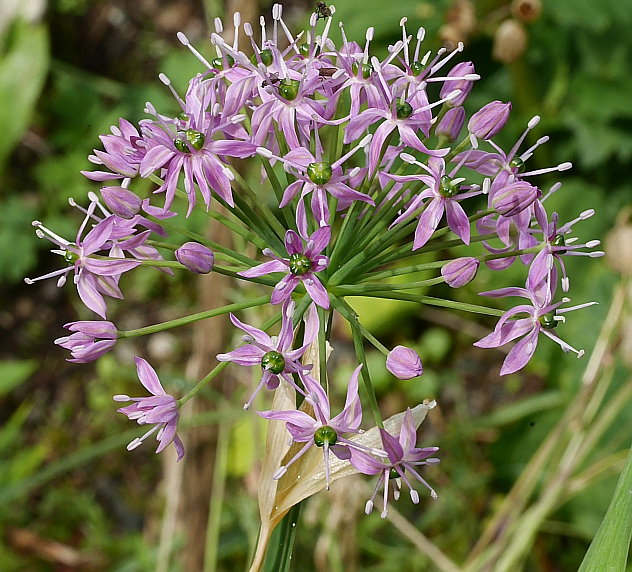
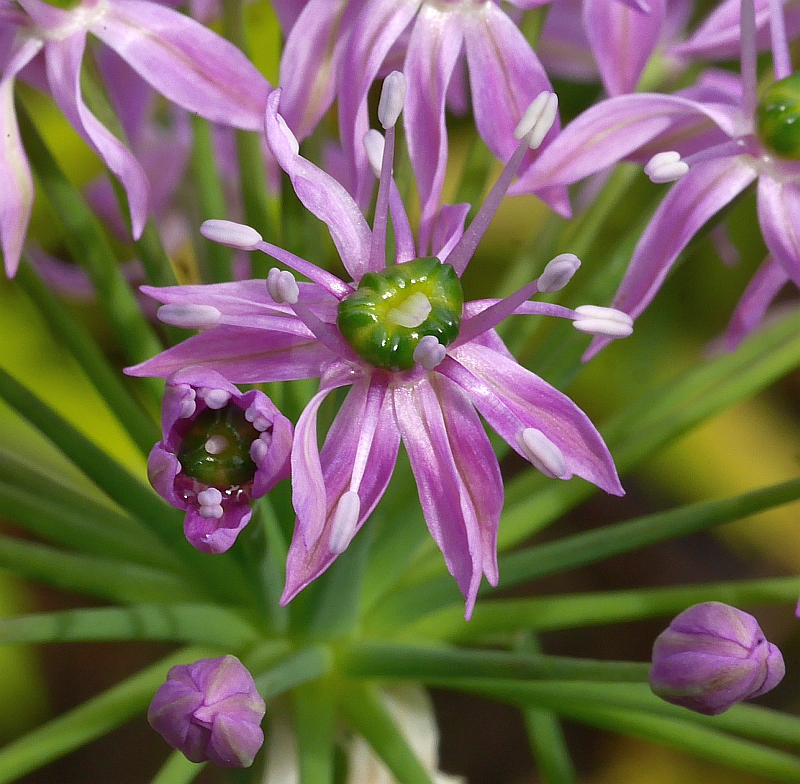
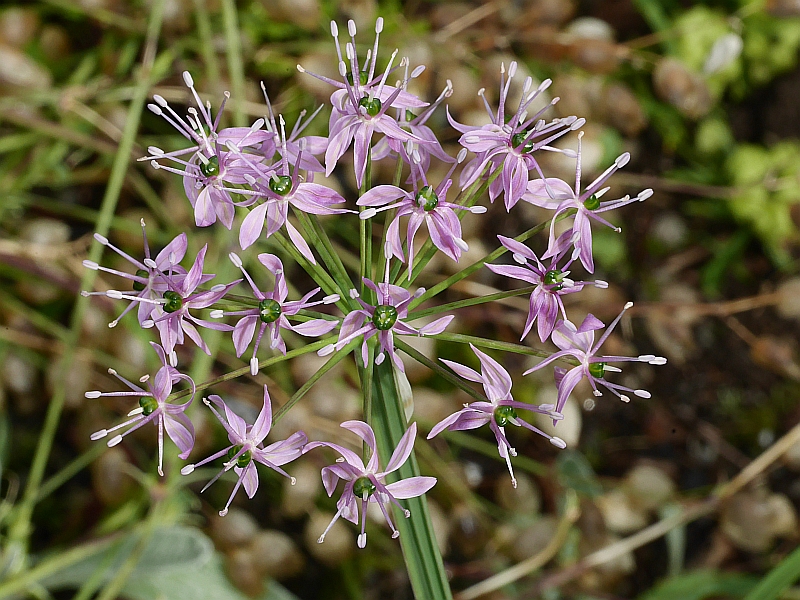
This is a nice new edimental Allium, although its identity is still being discussed by the experts!
I received seed of this a few years ago from my friend Hristo Hristov in Bulgaria under the name “mountain slizun” He wrote: “The woman who sent them to me is not an avid collector, so I highly doubt she knew it’s Latin name. I guess the seeds were collected near her city in Kazakhstan (map of the collection location: http://tinyurl.com/hdt5pk6)
Slizun is Allium nutans, but the name she called it could be just how she calls it”
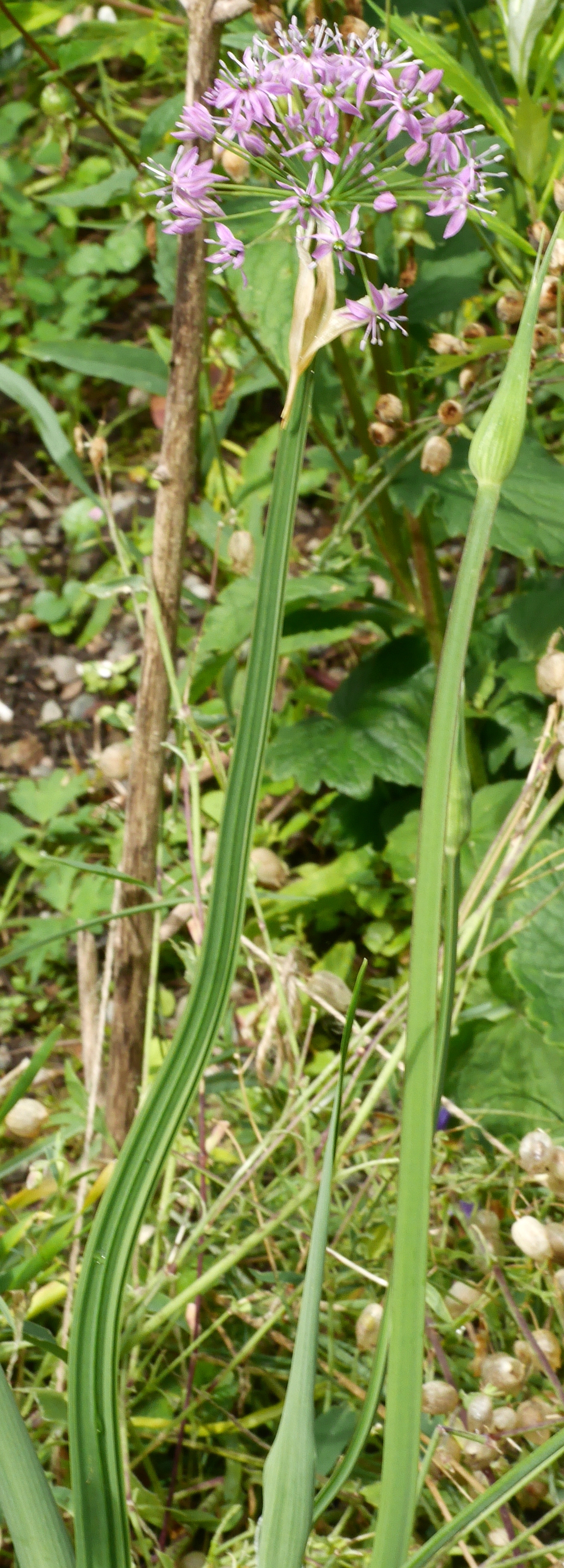
Based on pictures I posted on the Alliorum forum last year,Mark McDonough thought it’s probably a hybrid, although with close affinity to the flowers of Allium flavescens. However, the leaves of my plant are broader than that species. Other possibilities are both Allium senescens and A. nutans both of which are found in Kazakhstan. This year there was some variation in flower colour, one quite pink (I guess I planted several seedlings). Whatever it is, it’s a nice plant.


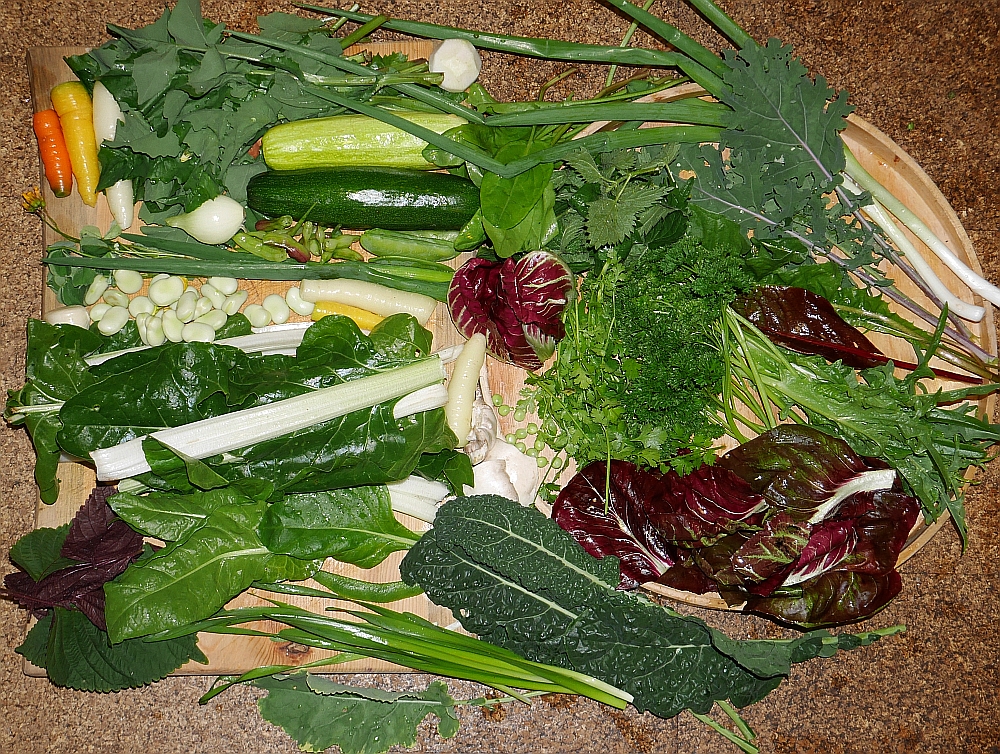

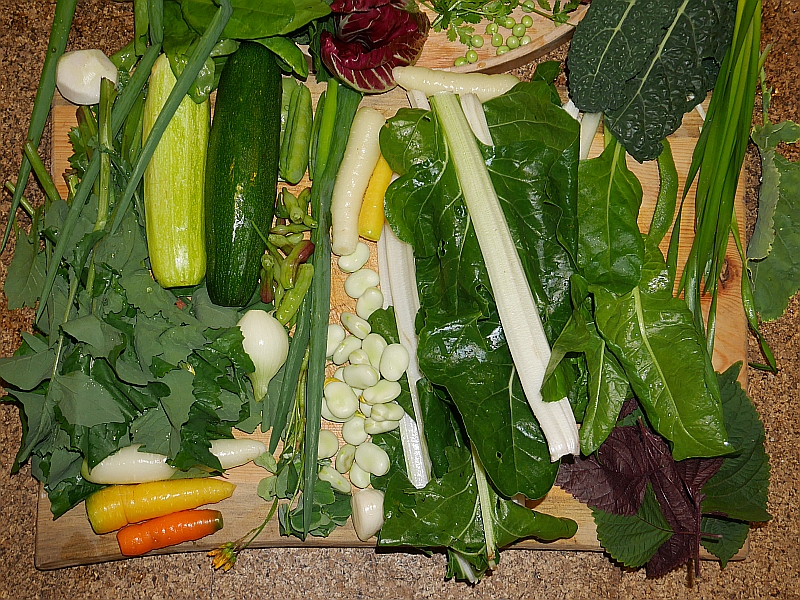


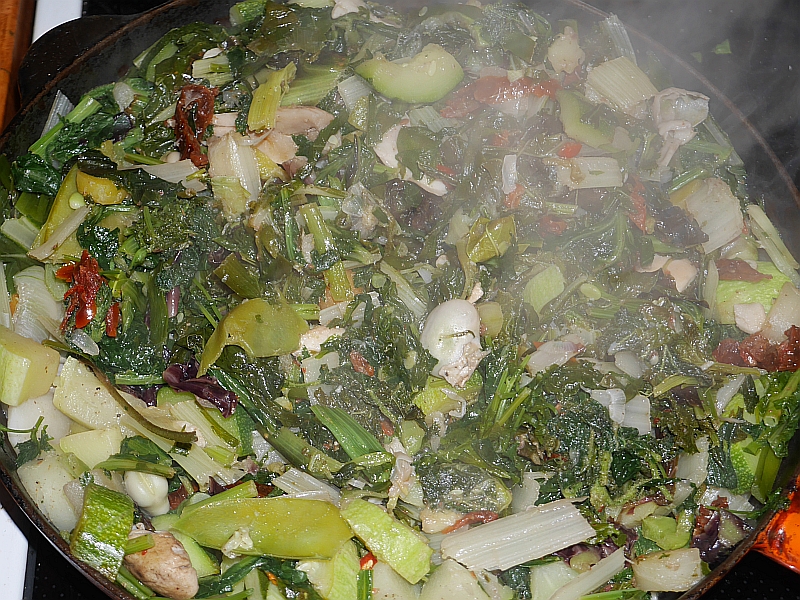
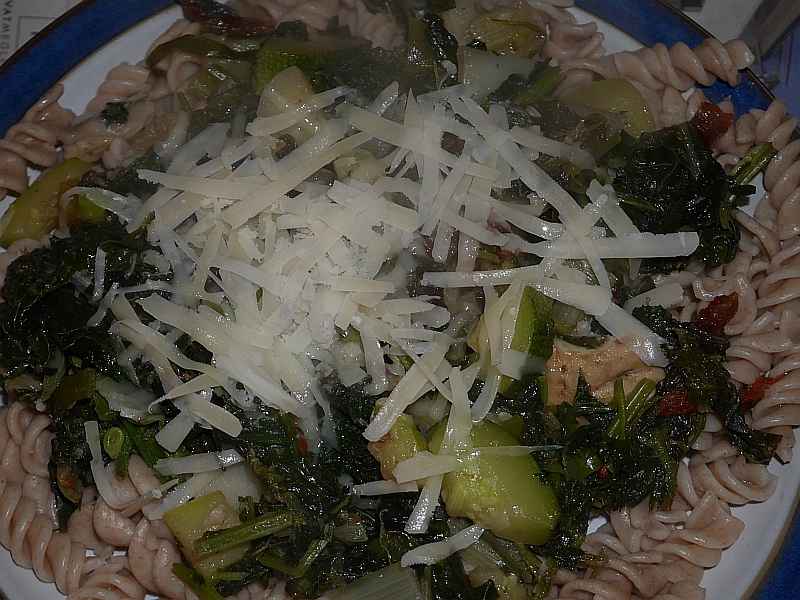














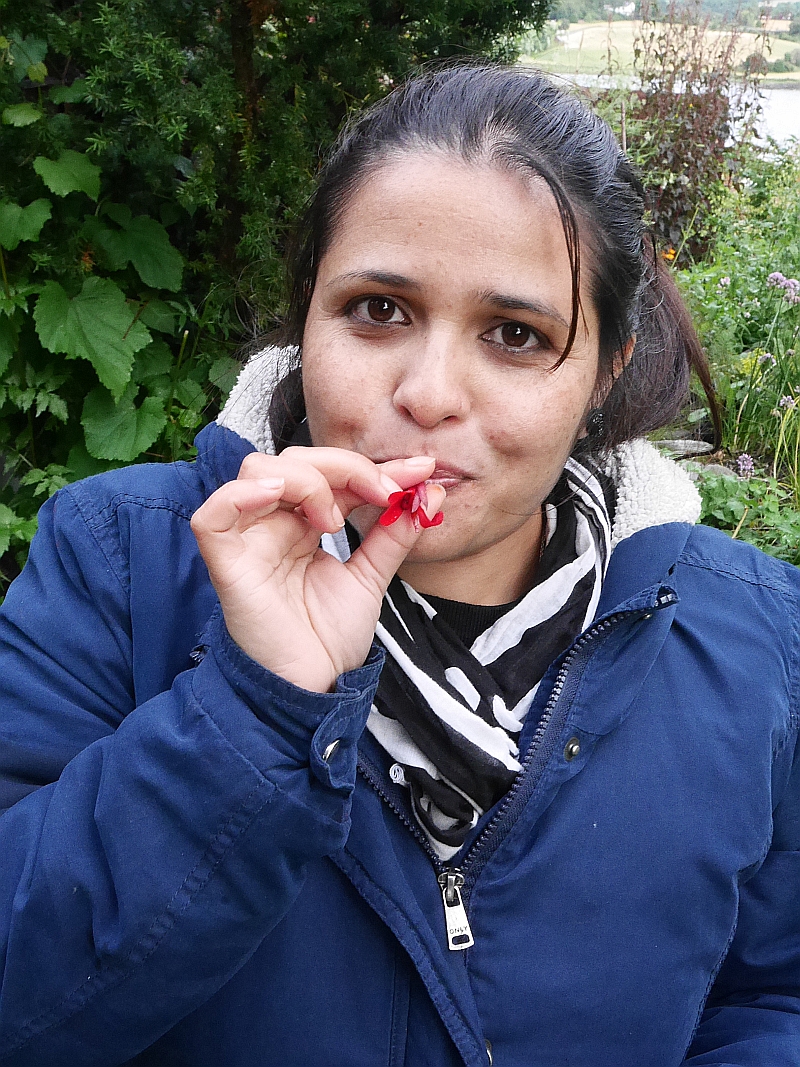
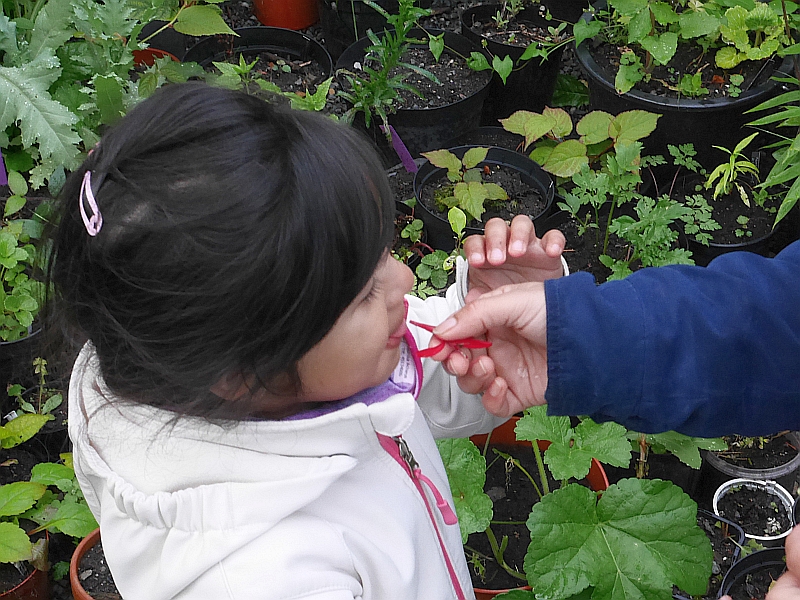
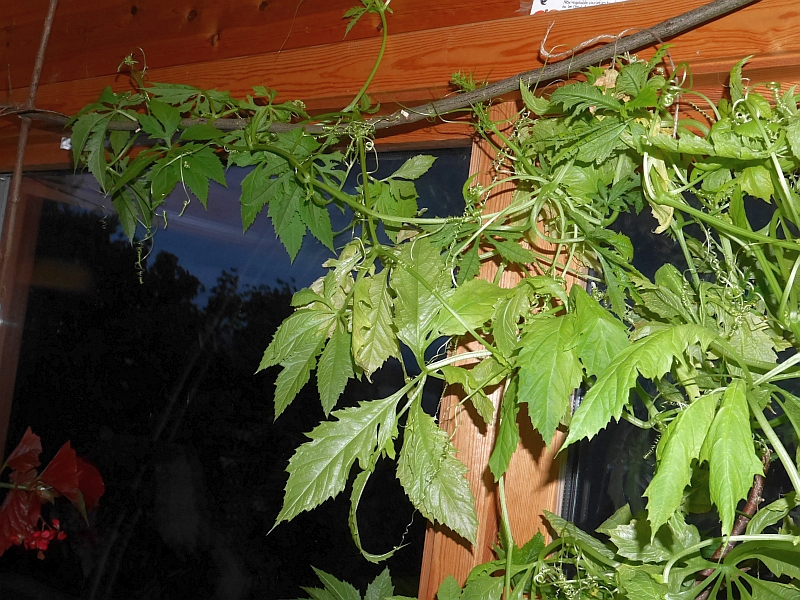
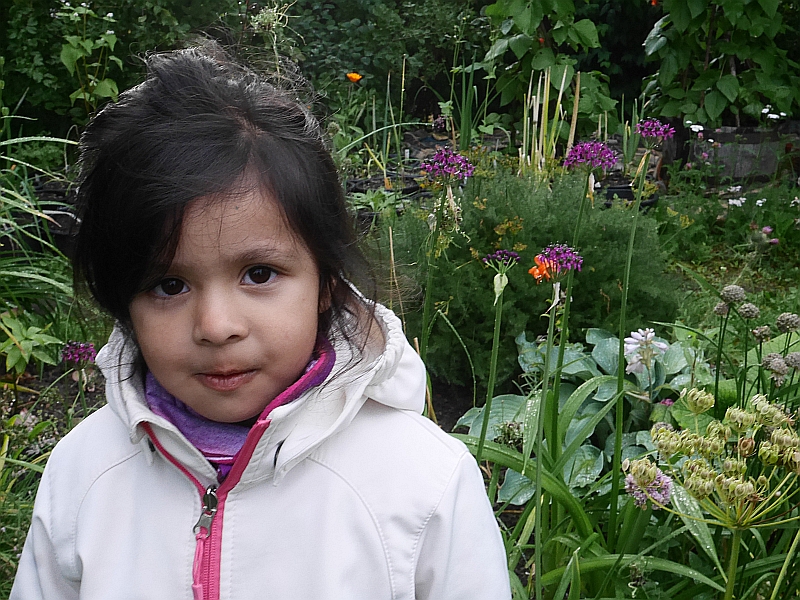
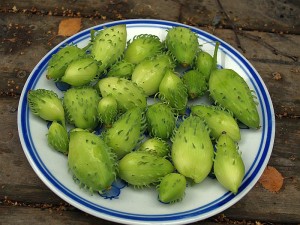 This is what I grew as Cyclanthera brachystachya “Fat Baby” in my old cold greenhouse in 2008. The picture was taken on 28th September.