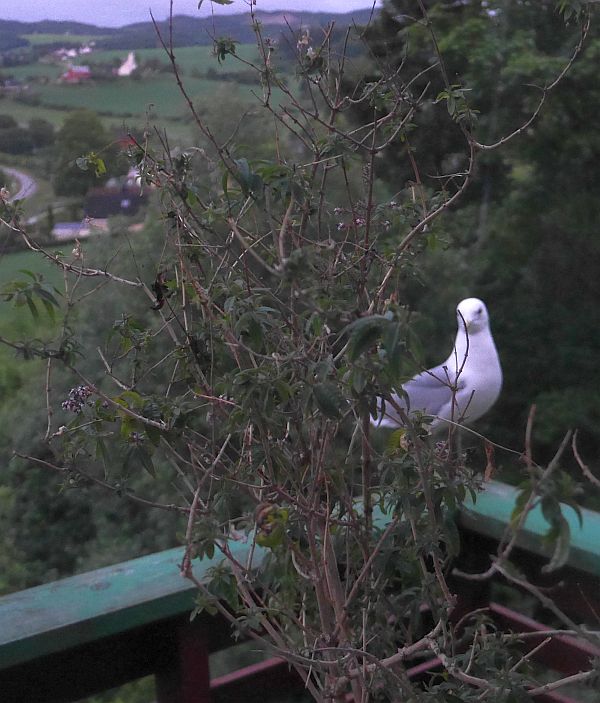
11pm last night and I opened the bedroom door onto the balcony and a common gull (fiskemåke) decided I was a bit too close to its chick that was somewhere in the neighbourhood and started shouting at me, even landing on the balcony!! I think they had a nest on one of the houses on the hill above me for the first time this year!
Harerug? Literally meaning “Hare rye” is a plant found in Norway from the outermost coast to the high mountains and is also one of the few edible plants of Svalbard in the high arctic! It’s Polygonum viviparum (Persicaria vivipara) or alpine bistort in English, in the Knotweed family or Polygonaceae along with many other edible plants such as giant rhubarb and Japanese knotweed and the sorrels and docks. Despite its small size, it has been an important survival food for arctic peoples including in some Norwegian mountain villages in the past as plants have comparatively large nutritious and tasty tubers! I’ve been using the bulbils (hence the latin viviparum meaning living birth as these fall off and form roots giving plants that are genetically identical to the mother plant). They have a delicious nutty taste, something my kids loved as a trail snack in the mountains. Indeed this is a plant one should learn if one is in the mountains as in the event of getting lost, one will still be able to find food. It is a particularly common plant above the tree line here!
It’s also circumpolar as the map in the album shows, even found in the alps and Himalayas. I have a number of different forms in my garden and there are also closely related species which are larger that I believe could have an even bigger potential as a cultivated mountain / arctic crop. There’s a robust subspecies in North America I’d love to get hold of…(Flora of North America: “… with large leaves, compact spikes, and persistent bulblets…. named subsp. macounii”). It’s also one of the 80 in my book Around the World in 80 plants!
Fresh bulbils from the garden…in nature two colour forms often coexist)
Harerug on the left, home grown opium poppy seed on the right
In my garden with an unidentified Chinese (?) species on the right
The tubers
Collected and drying on the window sill for winter breads and baked dishes
Habitat in the Norwegian mountains in the Sylane (Storerikvollen)…rhubarb also grows well next to the cabin
The long leaves are alpien bistort in the turf at Storerikvollen with alpine lady’s mantle (Alchemilla alpina)
Circumpolar distribution
It grows throughout Norway from the coast to the high mountains including in the arctic islands Svalbard, Bear Island and Jan Mayen
It’s also one of the 80 in my book Around the World in 80 plants
Perennial vegetables, Edimentals (plants that are edible and ornamental) and other goings on in The Edible Garden